
The fearful avoidant cycle is what people are trying to name when they describe the same relationship running hot and cold in the same week: a partner who moves closer, then goes quiet, then reappears as if nothing happened — or their own hand doing the reaching and the pushing in turn. This page holds the mechanism itself. The pages around it take the mechanism apart, piece by piece.
One promise before anything else. Nothing here is a diagnosis, and nothing here predicts what a particular person will do next. An attachment pattern is a description of tendencies, not a chart of someone’s insides. The cycle described below is recognisable precisely because it is a shape, and a shape is all it is.
What is the fearful-avoidant cycle?
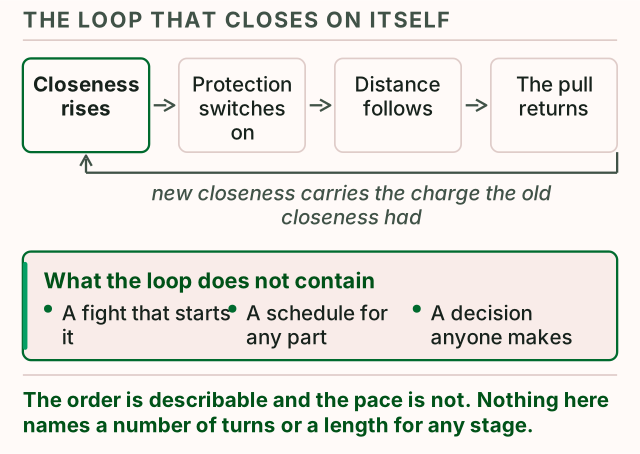
The fearful-avoidant cycle is the alternation that gives the style its name: closeness increases, a protective response switches on, distance follows, the pull toward the person returns, and the sequence begins again. Neither half is the “real” one. The wanting is not a performance and the withdrawing is not the truth finally coming out — the pattern is both running at once.
What makes this pattern distinct from its neighbours is the simultaneity. In the fearful-avoidant reading, the system that reaches for another person and the system that defends against them fire close together, on the same events. Closeness itself is the thing that raises the alarm, which is why the retreat lands where an outside observer would least expect it. For example: after the good weekend, after the honest conversation, after the moment the relationship visibly deepened.
That is also why the pattern confuses everyone involved, including its owner. A person who only wanted distance would leave. A person who only wanted closeness would stay. Someone running this cycle does both, in sequence, with full sincerity at every point — and then watches the wreckage with as much bewilderment as their partner does.
The word “cycle” earns its place because the sequence closes on itself. Distance is not the end state. Once the pressure of closeness drops away, the protective system quietens, and what is left underneath is the original pull toward the person. The reach that follows is not manipulation and not an apology tour; it is the other half of the same pattern getting its turn.
A note on names, because search results scatter them. “Fearful-avoidant cycle”, “fearful avoidant relationship cycle”, “disorganized attachment pattern” — these phrases all point at the same mechanism described here. “Disorganized” is the label from the research classification of attachment, set out in the volume where the disorganized category was described. “Fearful-avoidant” is the wording used about the same pattern in adults, from the four-category model of adult attachment. Whichever door someone came in through, the shape behind the door is the one on this page, and none of the names is a diagnosis.
What are the movements of the cycle?
The cycle reads most clearly as movements rather than stages. Stages imply a schedule, and this pattern has none: no source can honestly tell you how long any part lasts, and this site does not print intervals it cannot support. What repeats is the order and the logic, not the calendar.
The reach. The pattern begins the way any closeness begins — genuinely. Attention, warmth, disclosure, plans. From the inside this part feels entirely real, because it is. There is no strategy in it and no clock ticking behind it. Whatever happens later, the reaching was not a setup.
The switch. Somewhere inside the closeness, the protective response fires. The trigger is not conflict; it is the closeness itself — being seen, being depended on, depending on someone, hearing the relationship named out loud. The switch is fast, quiet, and ahead of awareness: the person does not decide to feel crowded any more than a startled hand decides to pull back from a hot pan. What reliably flips it is its own subject, covered on the triggers page.
The distance. What follows is the part people are trying to name when they reach for this vocabulary: pulling away, shutting down, going cold. In practice, contact thins, warmth arrives in a smaller format, and the reasons — real ones — line up behind the retreat. The mechanics of this movement, including what it looks like from each side, live on the deactivating page.
The return. With distance, the pressure drops; with the pressure gone, the protective system stands down; and what is left is the original pull toward the person. The reach that follows can look confusing or even careless from the outside — now you want to talk? — but inside the pattern it is consistent: the wanting was there the whole time, waiting for the alarm to stop.
Then the loop closes. New closeness carries the same charge as the old closeness, and nothing in the pattern itself teaches the switch to read it differently. That is the honest reason the cycle repeats: not because anyone enjoys it, but because each pass ends where the next one begins.
Why isn’t it just a mood swing?
Because it turns after closeness rather than at random, and it can leave the rest of a life level while one relationship swings. The nearest wrong explanation is temperament — that this is simply a moody person, and the relationship weather changes with them. The cycle fails that description on scope. Consider an ordinary mood: it colours everything — work, friends, food, sleep. This pattern can leave the rest of a life level while one relationship swings, because it is not about how the person feels in general. It is about how safe closeness feels with a particular person at a particular depth.
It also fails on direction. Moods are weather; they do not track events with this precision. The cycle turns after closeness, again and again, in what people on both sides of it describe — after the vulnerable conversation, after meeting the family, after the first time the word “we” carried weight. Withdrawal after a fight needs no theory. Withdrawal after the best week the couple has had is the signature of this pattern, and no account of moodiness explains it.
And it fails on feeling. A mood swing is felt as a change of state by the person having it. The switch described above is not felt as an event from inside — what registers is relief, a suddenly reasonable list of other priorities, and mild surprise that anyone is hurt. The absence of felt drama is exactly why arguments about the pattern go in circles: one person points at a change, the other honestly reports that nothing changed.
None of this makes the pattern harmless, and naming it is not the same as excusing it. The point of the distinction is practical: what helps with a mood — waiting it out, cheering someone up — does nothing for a cycle, because the cycle is not about the person’s state. It is about what closeness costs them, and that has to be addressed as its own thing.
Where each part is described
This page holds the shape; the detail is deliberately elsewhere. Each part of the cycle has one home on this site, and the homes do not repeat each other.
The section is written for both readers at once — the person who recognises their own hand on the switch, and the partner watching the weather change from the other side of the room. That is deliberate. The cycle only makes sense described whole, and each page below says plainly which side of it is being addressed, without turning either side into the guilty party.
What flips the switch. The situations that reliably set the protective response off — and what each one looks like from the outside — are collected on the triggers page. That page stays descriptive: what switches on, not whose fault it is.
The distance itself. The pull-away — what deactivating means in the fearful-avoidant reading, how it differs from wanting an evening alone, and what the quiet looks like from both sides — is the subject of the deactivating page. It is the deepest page in this section.
The cycle inside a couple. How the pattern behaves across a real relationship — dating, established couples, the partner’s side of the table — lives in the in-relationships section. If your question starts with “is this a test”, start there.
When the cycle ends a relationship. Breakups in this pattern have their own arc — the abrupt cut-off, the pull that returns after it — and their own section: breakups. Nothing there promises an outcome; it describes the shape of what happens.
Whether the cycle can change. What movement toward a more secure pattern actually looks like — smaller swings rather than none — and where description ends and professional work begins, is the healing section. It is the only part of this site that talks about change, and it does so without a program and without a deadline.
Read in that order, the section builds one picture: a switch, a retreat, a return, and a loop that closes — plus the honest limits of what a description can do about it.
What we send
The cycle, one letter at a time
That did not go through. Nothing was saved and nothing was sent — try the address again, or write to us directly and we will add it by hand.
- It never tells you what you are, or what anybody else is.
- It carries no figures, because this guide publishes none.
- It arrives when a page changes, and stays quiet when none does.
A description of the mechanism, not a program. Unsubscribe anytime.