
Search for fearful avoidant triggers and the results promise lists. This page gives a list too, but with the mechanism attached, because the list alone is misleading: the same event — a warm message, say — can be a trigger on Tuesday and nothing on Friday. What makes something a trigger in this pattern is not the event but what it does to the distance in the relationship. This page walks through the situations that reliably start the approach–withdraw cycle, what each one switches on, and how the response looks from the outside.
Fearful avoidant triggers are the events that change the closeness or the sense of threat in a relationship fast enough to start the approach–withdraw cycle — and in this pattern they arrive from both directions, closeness as reliably as distance.
What counts as a trigger in this pattern?
A trigger is, as this site uses the word, any event that changes the closeness or the sense of threat in a relationship quickly. That is an everyday definition, chosen on purpose: it is not the clinical sense of the word, and nothing here describes flashbacks, panic, or responses that belong in a consulting room.
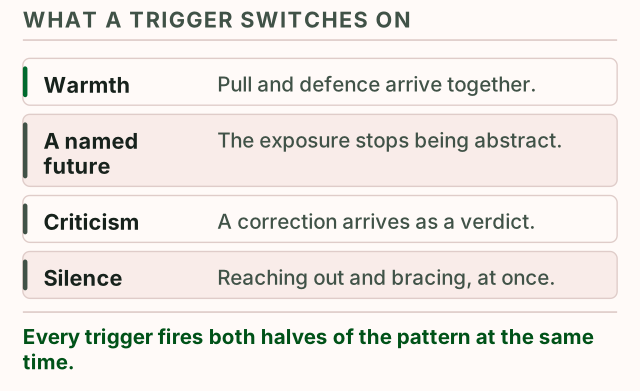
The fearful-avoidant pattern, as the attachment literature describes it — see Mikulincer and Shaver on the attachment perspective on emotion regulation — runs two systems close together — a pull toward connection and a push toward safety — and a trigger is whatever fires them. The signature is that both fire at once. Something that raises closeness activates the alarm about exposure; something that raises threat activates the wish to reach for the very person who now feels unsafe. That is why the visible response so reliably looks contradictory: a step forward wrapped inside a step back. The behaviours this produces are catalogued on the signs page; this page is about what sets them off.
One consequence of the two-system setup is worth stating early: triggers here come from both directions. Closeness can start the cycle as reliably as distance can. A pattern that only reacted to a partner pulling away, or only to a partner coming near, would be a different pattern.
| Trigger | What switches on | What it looks like from outside |
|---|---|---|
| A partner getting warmer | Pull toward the closeness and alarm at the exposure, together | Distance arriving right after the best stretch |
| A plan that makes the future concrete | A scan for the exit — commitment lands as a closing door | Enthusiasm in the moment, stalling or cancelling after |
| Silence or a flat reply | Threat-reading — the gap fills with the worst explanation | Urgent reaching out, then retreat once the answer comes |
| Criticism, even mild | Shame — the comment lands as confirmation of an old verdict | A defence out of scale with the remark, or a full shutdown |
| Being seen at a vulnerable moment | Exposure alarm — openness reclassified as a mistake | Sudden coldness after an unusually honest conversation |
| A partner's attention going elsewhere | Jealousy read as evidence of being replaceable | Testing and checking, or a pre-emptive pulling away |
What are the closeness triggers?
They are the events that move a relationship closer faster than the safety system can process: a partner getting warmer, a plan that makes the future concrete, being seen at a bad moment. The counterintuitive direction first. In this pattern, things going well is a trigger category of its own, and the least visible one, because nobody expects the alarm to sound at a good moment.
A partner getting warmer. What switches on is both systems at once: the warmth is genuinely wanted, and its arrival removes the distance that was quietly doing the work of safety. From outside, this looks like the classic sequence partners report — a close, open weekend followed by shorter messages and a cooler tone, with no argument anywhere to point to. The retreat tracks the high point, not a grievance.
A plan that makes the future concrete. Meeting family, a shared lease, a holiday booked months ahead. What switches on is a scan for the exit: commitment, in this pattern, lands less as reassurance and more as a door closing. From outside it looks like enthusiasm in the conversation and stalling afterwards — the plan agreed to warmly and then postponed, renegotiated, or cancelled.
Being seen at a bad moment. For example: crying in front of a partner, admitting a fear, being caught in a failure. What switches on is the exposure alarm: the openness that felt right in the moment gets reclassified, in the hours after, as evidence handed to someone who could use it. From outside, this is the coldness that follows an unusually honest conversation — the partner is left wondering how the closest evening of the month produced the most distant week.
What these three share is direction: each one moves the relationship closer, faster than the safety system can process. When the response to that is a full retreat, the shutdown that follows has its own machinery, described on the deactivating page.
What triggers come from distance and silence?
Anything that reads as the relationship cooling: an unexplained silence, a flat tone with no story attached, a partner pulling back for reasons of their own. The other direction is more intuitive, and it is the side of the list that overlaps with what people mean by fearful avoidant abandonment fears — scoped, here, to how this specific pattern handles them.
Unexplained silence. Consider a message left on read overnight, or a day without contact from someone who is normally in touch. What switches on is threat-reading: the gap gets filled with the worst available explanation, and the explanation feels like information rather than guesswork. From outside, this looks like urgency — repeated messages, a call, a question that arrives with more weight than the silence seemed to deserve — followed, once the answer comes, by a retreat, because the reaching itself now feels like exposure.
A flat tone with no story attached. Shorter replies, less warmth, a partner distracted by work. What switches on is the same threat-reading at lower volume: the change is detected long before it is checked, and the reaction arrives before the question does. From outside, the response looks disproportionate, because the observer measures it against the tone, not against what the tone was taken to mean.
A partner pulling back for their own reasons. Grief, stress, an ordinary busy stretch. What switches on is the oldest version of the alarm — the read that distance means leaving. The visible response splits: some reach, some match the distance and exceed it, and the same person may do each on different days. That split is the pattern in miniature.
The tell, across this whole section, is that the trigger is the change in distance rather than the distance itself. For example, an established long-distance rhythm can be tolerable while a brief deviation from a close rhythm is not.
Why does criticism land so hard?
Because it works through shame, and shame is the accelerant in this pattern. Criticism deserves its own section for that reason: it does not work like a closeness or a distance trigger.
The sequence people describe: a remark lands — sometimes a genuine criticism, sometimes a neutral comment with an edge read into it — and rather than being processed as information about a behaviour, it is received as confirmation of a verdict that predates the relationship: there is something wrong with me, and now they have seen it. This is what searches for the fearful avoidant shame spiral are pointing at. The shame spiral is that loop feeding itself: the shame triggers a defence, the defence is out of scale with the remark, the overreaction itself becomes new evidence for the verdict, and round it goes.
From outside, this shows up as two very different pictures from the same person. Sometimes the response is loud — a counterattack that treats a small note as an accusation. Sometimes it is silent — a shutdown mid-conversation, the shutters visibly coming down. Which one appears can depend on how close the relationship had just become, because criticism that arrives during a vulnerable stretch lands on defences that are already down.
Timing is the practical takeaway for partners: the same words carry different weight at different moments, and a correction offered right after an open, close period is received very differently from the same correction on an ordinary day. The shame response is also the engine behind the behaviour people label self-sabotage — the verdict they will leave once they see me makes leaving first feel like safety — and that connection is unpacked on the self-sabotage page.
Why does jealousy read differently here?
Because of what it switches on. Jealousy appears on trigger lists for any attachment pattern; what makes fearful-avoidant jealousy its own entry is that it fires both systems at once.
In this pattern, a partner’s attention going elsewhere is not just a rival-shaped threat. It lands as evidence for the standing verdict — replaceable, and about to be replaced — which means it triggers both systems at once, like everything else here. The connection system says get closer, confirm, hold on. The safety system says the confirmation is coming anyway, so leave before it arrives. From outside, that produces the double picture partners find hardest to read: checking, testing, and questions on one day; a cold, pre-emptive withdrawal on another. The person seems both more invested and less reachable at the same time.
The pre-emptive move is the distinctive part. Jealousy gets pictured as driving pursuit; here it can just as well drive an exit — ending things, or hollowing them out, so that the feared leaving happens on the pattern’s own terms. If a partner’s jealous-seeming behaviour alternates with retreat rather than escalating toward pursuit, this mechanism is the more likely reading.
A boundary for this section: jealousy that comes with monitoring, control, or fear belongs in a different conversation entirely, and no attachment frame should be used to excuse it.
What this page doesn't do
- No trigger-avoidance playbook
- We do not offer scripts for keeping a fearful-avoidant partner permanently untriggered. Distance in a relationship changes; a strategy built on it never changing is not a strategy.
- No regulation protocols
- Breathing exercises, grounding sequences and nervous-system routines are practitioner territory. This page describes what switches the cycle on, not procedures for switching it off.
- No clinical reading of the word
- Trigger here means an everyday prompt, not the clinical term. Responses involving flashbacks, panic or feeling unsafe deserve professional attention, not a website's vocabulary.
- No leverage
- A trigger list can be read as an instruction manual for provoking a reaction. Nothing here works as a lever, and using it that way harms both people.
Where this page stops
This page describes situations that people who recognise the fearful-avoidant pattern report as the start of the cycle; it cannot see any individual reader’s situation. An attachment pattern is not a diagnosis, and a page like this cannot distinguish a strong reaction inside a relationship habit from a response that belongs to something clinical — including reactions that feel bodily, involve losing time or feeling unreal, or attach to memories that are hard to look at. If what gets switched on in you, or in your partner, feels bigger than the situations described here, that is worth taking to a therapist or a doctor, who can see the whole situation where a page sees only a pattern.
What we send
What flips the switch, in one letter
That did not go through. Nothing was saved and nothing was sent — try the address again, or write to us directly and we will add it by hand.
- It never tells you what you are, or what anybody else is.
- It carries no figures, because this guide publishes none.
- It arrives when a page changes, and stays quiet when none does.
No schedule, no sequence, no course. One link in every letter takes you off the list for good.