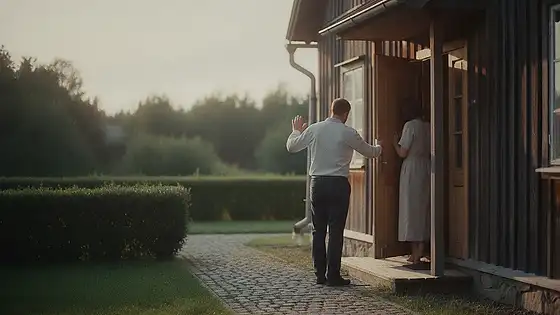
People look up disorganized attachment style in relationships from the middle of a confusion, not out of curiosity: a partner who was fully present on Saturday and unreachable by Tuesday, a friendship that cools without a fight, or their own hand hovering over a message they want to send and cannot. This section of the site is about that middle ground — not what the pattern is, which the style pages cover, but what it does once a relationship is actually running.
Disorganized attachment style in relationships is that alternation seen from inside a pair: involvement that is real and often intense, a retreat set off by the closeness rather than by anything going wrong, and a return once distance has started to feel safe again.
One clarification before the tour. Attachment language is a description of behaviour around closeness; it does not grade people. A person whose behaviour fits the fearful-avoidant (disorganized) description is not a worse partner or a worse friend by definition — they are running a harder sequence, and the sequence is what this page describes.
How does the pattern act in a relationship?
Inside a relationship the pattern shows as alternation where a partner expects steadiness. Involvement is real and often intense — attention, closeness, plans — and then a retreat arrives that nothing visible explains, because it was set off by the closeness itself rather than by anything that went wrong. Once distance is re-established and feels safe, the pull toward the partner returns, and the sequence starts again.
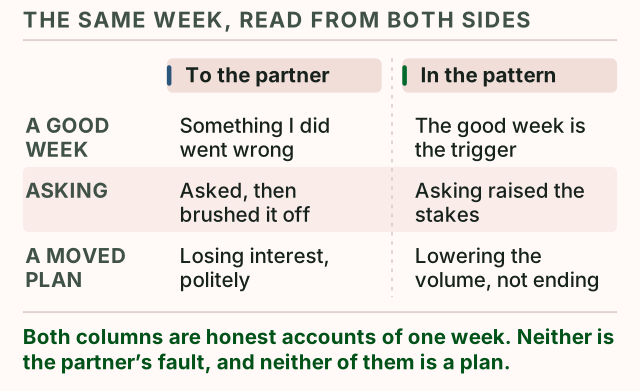
A concrete example makes the shape easier to see. Consider a couple who have their best weekend in months: open conversation, real ease, talk about the future. In the days that follow, the messages get shorter, a plan is postponed, and the warmth goes flat — not after a fight, but after the good weekend. A week or so later the same person reaches back, warm again, with no account of the gap. The example is the sequence, not any single move in it; each move alone has plenty of innocent explanations.
This is also what the searches for “disorganized attachment in adulthood” are reaching for. The frame comes from research on children — Bowlby’s Attachment and Loss and Ainsworth’s work on infant–mother attachment — but the adult version lives in exactly these scenes: commitments, messages, weekends, the distance after the good moment. Adulthood does not outgrow the pattern; it gives the pattern more surface to act on. The machinery underneath — what sets the retreat off and how the shutdown runs — is described step by step in the cycle section; this page stays with what a partner or friend can actually observe.
The alternation is also what separates the pattern from an ordinary need for space. Wanting an evening alone, or a slower pace early on, is a preference: it can be named, it does not spike after closeness, and it does not reverse into pursuit once granted. The pattern is different on each count — the distance resists explanation even from the person taking it, it follows the good moments, and it converts back into reaching the moment it succeeds.
Other behaviours belong in the observable list as well. For example, reassurance gets requested and then deflected — “are we okay?” followed by an inability to absorb the answer. And connection gets tested rather than asked about: a silence to see who breaks it, a withdrawal staged to see whether it is noticed. From the receiving end, a test and fading interest look identical, which is why the difference gets its own page at testing or love.
“Am I fearful-avoidant?” — what do people recognise?
Self-recognition with this pattern runs through behaviour in a pair, not through a quiz, and this site deliberately does not offer one. A score would imply a threshold, and a threshold would imply a classification — which is more than a descriptive frame can honestly deliver. What people who identify with the pattern report instead is a set of recognitions, and they are specific.
The first is wanting opposite things at once: genuine longing for closeness and, the moment it becomes available, an equally genuine need to get away from it. The second is the timing — noticing that their own retreats follow good moments, not bad ones. The third is the double feeling when distance finally arrives: relief and loss at the same time, both real. People also recognise the reassurance loop from the inside: asking the question, receiving the right answer, and finding that it will not stick.
The honest test is repetition. Anyone can have a guarded season after a hard relationship; what makes a pattern is the same sequence arriving across different relationships, with partners who behave differently from each other. If the description keeps fitting when the cast changes, it is worth taking seriously. The behavioural signs are laid out one at a time on the signs page — as descriptions to recognise, not items to score.
How does the pattern show up in friendships?
The same alternation runs in friendships, at lower volume. In practice, closeness with a friend builds over months, then a stretch of unexplained unavailability follows exactly the period when the friendship deepened. Invitations get declined with thin reasons. Messages sit unanswered — not from indifference, but because answering re-opens a closeness that currently reads as pressure. Then contact resumes, warm and ordinary, as if the gap had not happened.
Friendship hides the pattern well, for a structural reason: friends hold less expectation of constancy than partners do. A couple notices a withdrawn week immediately; a friend files it under busy. So the pattern in friendship tends to be read as flakiness or fading interest, and the person running it tends to accumulate warm, interrupted friendships — real affection on both sides, punctuated by distances neither side can name.
The inside experience is the same collision in miniature. A close conversation with a friend can set off the same wish to disappear afterwards that a romantic weekend does. People who recognise themselves in this often say friendships feel safer than romance — which is true in the sense that the alarm is quieter, and misleading in the sense that the alarm still rings.
What happens when both partners have the pattern?
Search asks about pairings directly, and the honest answer starts the same way for all of them: labels do not decide compatibility, and no pairing is doomed or guaranteed by its combination of styles.
When both partners lean fearful-avoidant, the recognisable feature is synchronised instability: each person’s retreat can set off the other’s alarm, so the couple swings between periods of real intensity and periods where both have withdrawn and neither can initiate the return. The repair that follows can be equally fast — both people know the road back from distance — but the relationship gets little practice at ordinary, uneventful steadiness, because calm is precisely the state the pattern distrusts.
The fearful-avoidant and dismissive-avoidant pairing is a different shape again. Both people withdraw under pressure, but for different reasons: the dismissive partner treats distance as home, the fearful-avoidant partner flees to distance and then aches inside it. Quiet stretches can get long, since neither reliably becomes the one who reaches back, and the fearful-avoidant partner’s returning pull can meet a partner who was comfortable where things were. What separates the styles themselves — the ache versus the ease inside distance — is drawn out on the comparison page.
In either pairing, the useful move is the same: name the mechanism rather than the person. “We both go quiet after close weekends” is workable. “You are the problem” is not, in either direction.
Can relationships with fearful avoidants work?
Some do, and some do not, and this site will not pretend to know which yours is. What can be said honestly is narrower and still useful. The pattern predicts difficulty, not outcome: the alternation strains trust, communication does extra work, and steadiness has to be built deliberately rather than assumed. None of that is a verdict.
What tends to matter, in the accounts people give, is whether the cycle can be seen and named by the people inside it. A retreat that both partners can recognise as a retreat — rather than as proof of fading love or of a partner’s coldness — loses some of its power to escalate. That noticing is slow work, it is not owed to anyone, and it cannot be done to a partner from the outside; the pages for partners are clear that supporting someone is not the same as managing them. What that support realistically looks like is the territory of loving someone with this pattern, and what movement toward a more settled pattern involves is described in the healing section — without timelines and without promises.
What this page will not do is convert the pattern into advice about staying or leaving. That decision belongs to the person inside the relationship, with the whole picture in view — and no attachment label is the whole picture.
What this section doesn't do
- No verdicts on your relationship
- A pattern description cannot see a particular couple. Nothing here says whether a relationship will work, and nothing here should be read as advice to stay or to go.
- No quiz and no score
- Self-recognition on this site runs through behaviour described precisely, not through a checklist that converts reading into a classification.
- No tactics
- Nothing here explains how to make a fearful-avoidant partner chase, commit, or miss anyone. Behaviour used as a lever on another person is the opposite of what these pages describe.
- No blame in either direction
- Some readers here recognise a partner, others recognise themselves. The pattern explains behaviour; it does not make either person the guilty party.
Where each part is described
This hub holds the map; the detail lives in its pages. The question of whether a confusing behaviour is a test or an expression of love — a question that keeps returning in this territory — is taken apart at testing or love. The early phase, including the texting patterns that send people searching, is described at dating a fearful avoidant. The partner’s side — what support looks like, what is not a partner’s to carry — is at loving someone with disorganized attachment.
Everything on this page ultimately points back to one mechanism: the approach–withdraw cycle, its triggers, and the shutdown people describe from the inside. That machinery has its own section at the cycle, and reading it first makes every page here easier to use.
What we send
The pattern in a pair, one letter
That did not go through. Nothing was saved and nothing was sent — try the address again, or write to us directly and we will add it by hand.
- It never tells you what you are, or what anybody else is.
- It carries no figures, because this guide publishes none.
- It arrives when a page changes, and stays quiet when none does.
No schedule, no sequence, no course. One link in every letter takes you off the list for good.