Search for how to heal fearful avoidant attachment and the results split into opposing piles: programs that promise a secure attachment style by a deadline, and clinical material written for practitioners. This page is neither. It describes what “healing” actually refers to when people who live with this pattern — or love someone who does — use the word, what tends to change and in what order, and where a description like this one has to hand over to a professional. The same applies if you arrived here searching for how to heal disorganized attachment: both names point at the same pattern, and this is its change section.
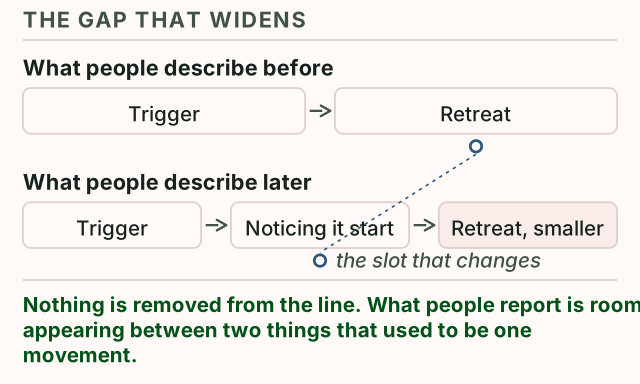
Healing fearful-avoidant attachment is not the removal of the pattern. What people describe is a widening gap between the trigger and the retreat: the alarm still fires, but it gets noticed while it runs, named for what it is, and stops converting automatically into distance.
Something to hold onto before any of it. An attachment pattern is not a diagnosis, and this site does not treat anything. What follows is a map of what change looks like from the outside and the inside — drawn carefully, and honest about its edges.
What does healing mean for this pattern?
For the fearful-avoidant pattern, healing does not mean the pattern is removed. What people describe — and what the attachment literature calls movement toward “earned secure” — is a widening gap between the trigger and the retreat: the protective response still fires, but it gets noticed while it is happening, named for what it is, and no longer converts automatically into distance. The alarm stays; its authority shrinks.
That definition matters because the alternative definitions quietly promise the wrong thing. If healing means “closeness stops setting off the alarm”, then any return of the alarm reads as failure, and the person concludes the work didn’t take. If healing means “become a different kind of person”, the project is unfalsifiable and endless. The gap definition is smaller and better: the same wave arrives, and more of the person is present while it passes through.
It also relocates where change shows up. On this definition, progress is not a feeling of being healed — it is a difference in what happens next. For example: the withdrawal that used to swallow whole weeks passes in an evening. The message that used to go unanswered gets a reply that says I need some room, I’m not gone. The relationship that used to end at this exact point doesn’t. None of that is dramatic, which is precisely why people in the middle of it tend to miss that it is happening.
And it explains why the word “heal” sits so awkwardly here. Wounds heal by closing; patterns change by being interrupted, over and over, slightly earlier each time. The vocabulary of injury suggests an endpoint. The vocabulary of pattern suggests practice. This section uses the latter, and says so wherever the difference matters.
What changes first?
The earliest change is not behavioural but narrative: the account of the pull-away moves closer to the event itself. What used to be explained weeks later (“I don’t know what happened, I just went cold”) becomes visible in the rear-view mirror the next morning, then in the evening it happens, then — much later — while it is still underway. The behaviour can look identical from outside during all of this. The person inside it is watching something they used to only reconstruct.
That reordering is the hinge for everything else, because the pattern’s power has always depended on being invisible at the moment it runs. In practice, the retreat never announces itself as a retreat; it arrives dressed as a reasonable list — too busy this week, not sure about this relationship anyway, need to focus on myself. When the person starts recognising the costume, the list loses its self-evidence. The doubts may still be there, but another question now stands next to them: is this the pattern again? That question, asked in real time, is the change.
What follows from it, gradually, is a change in what the distance does. Withdrawal that is noticed can be named to a partner, and named withdrawal behaves differently from silent withdrawal: it stops being a verdict and becomes an event in the relationship, something the couple has words for. The swings continue, smaller. The recoveries shorten. The apologies arrive closer to the thing they are for.
What do people describe doing?
What follows is a description of what people who report movement in this pattern say they did, collected from first-person accounts and from the way the attachment literature frames change; for the adult side of that literature, Mikulincer and Shaver’s open-access review of adult attachment is a compact starting point. It is not a program, the items are not steps, and this site cannot tell you which of them — if any — belongs in your situation.
Learning the pattern’s shape in their own history. Before anything changes in real time, people describe recognising the loop retrospectively: the same arc — warmth, alarm, distance, return — drawn across different relationships that had seemed like unrelated stories. Reading a description and finding their own sequence in it is what makes the real-time noticing possible later. That shape, and what reliably sets it off, is mapped on the triggers page.
Saying the pattern out loud to the person it lands on. Consider a move that keeps returning in these accounts: telling a partner about the pattern before it runs, so that the pull-away, when it comes, has already been introduced. This changes the partner’s position from target to witness. It is also frightening in exactly the way the pattern predicts — being known is the trigger — which is why people describe it as the hardest small thing they did.
Staying through the urge instead of acting on it, in small doses. Not heroically, and not by force. What gets described is choosing, sometimes, to remain in contact while the urge to withdraw is present — sending the honest message instead of the silence, staying in the room for the rest of the conversation — and discovering that the urge crests and passes without the exit. Each such pass is a small piece of evidence against the alarm.
Watching the aftermath of closeness, not just the closeness. People report that the dangerous moments are not the intimate ones but the mornings after them — the point where the pattern quietly starts assembling reasons. Knowing where in the week the sabotage tends to begin lets it be caught as a pattern rather than obeyed as a conclusion. Why things break precisely when they are going well has its own page.
Working with a therapist. Professional help is a recurring part of how people describe real movement in this pattern, and the reasons are practical: the pattern formed in relationships, and a therapeutic relationship is a place where it can run — and be interrupted — with someone whose job is to hold that safely. This site does not recommend methods or practitioners, and it is not a substitute for that room. What it can say is that seeking that help is a normal part of how this change happens, not an admission that something is wrong with the person.
Notice what is absent from this list: no scripts, no schedules, no daily practices. Not because those never help anyone, but because prescribing them is practitioner work, and a page that cannot see you should not be assigning you exercises.
What this page cannot do
What this section doesn't do
- No program
- There is no sequence of steps here, no plan and no schedule. Change in this pattern is not a course to complete, and a site that cannot see your situation has no business assigning one.
- No timeline
- No answer is given to "how long does it take", because no honest answer exists. Any page that names a number of weeks or stages for this is publishing a guess in the costume of a fact.
- No method recommendations
- Named therapy approaches are not reviewed, ranked or recommended here. Choosing a kind of professional help is a conversation with a professional, not a comparison table.
- No promised outcome
- Nothing here guarantees a secure attachment style, a saved relationship, or a returned ex. Descriptions of change are not offers of it, and reading about the pattern is not the same as moving it.
Where this page stops
This section describes what change in an attachment pattern looks like; it cannot see any individual reader, and it cannot tell the difference between a relationship pattern and something that needs clinical attention. An attachment style is not a diagnosis, and nothing here rules one in or out. If the reactions described on this site come with distress that spills beyond relationships — or if the history behind them feels heavy to carry — the right next step is a conversation with a therapist or a doctor, who can see the whole picture and say what kind of help fits. How this site checks the claims it does make is documented on the sources page.
Where each part is described
This page holds the definition of change; the detail lives in its spokes, and each spoke has its own job.
What movement toward secure actually looks like. The phrase “earned secure”, what changes in the order people notice it, and what a steady partner can and cannot do — including why “success stories” make poor evidence — is the subject of the becoming-secure page. It is the page for the question can this actually change, and into what?
Why it breaks when it’s going well. The most recognisable healing obstacle in this pattern is the one it generates itself: things improve, and the improvement sets off the alarm. The cancelled plans, the sudden criticism, the evaporating feelings — described as a sequence rather than a character flaw — are on the self-sabotage page.
What switches the pattern on. Change begins with recognising the moments the protective response fires, so the map of those moments — the triggers page — is effectively the first page of this section, even though it lives with the cycle.
Read together, these pages make a deliberately modest claim: the pattern can move, the movement has a recognisable shape, and describing that shape honestly — without a deadline, a program, or a promise — is the most a guide like this can offer.
What we send
The pattern, described letter by letter
That did not go through. Nothing was saved and nothing was sent — try the address again, or write to us directly and we will add it by hand.
- It never tells you what you are, or what anybody else is.
- It carries no figures, because this guide publishes none.
- It arrives when a page changes, and stays quiet when none does.
A description of how the cycle moves, not a program. Unsubscribe anytime.