
Two kinds of readers search for fearful avoidant deactivating. One has just received a version of “I need some space” — after a good weekend, not a bad one — and is trying to work out what changed. The other is the person who sent it, watching themselves go cold toward someone they wanted badly a week ago, without being able to say why. This page describes the same event for both of them.
Deactivating is one phase of a larger loop — the reach-out, push-away alternation described on the cycle overview. What follows is the shutdown half of that loop: what it is, why it lands at the strangest possible moment, how it looks from the outside, and what can and cannot be read from it.
What does deactivating mean for a fearful avoidant?
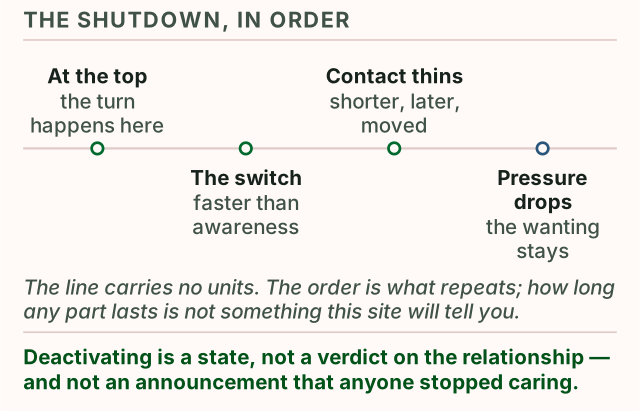
Deactivating is the state in which the attachment system’s volume gets turned down: the felt need for the other person drops, contact starts to feel like pressure, and distance starts to feel like air. In a fearful avoidant, this happens while the wish for closeness is still alive underneath — which is what makes the fearful-avoidant version different from simple disinterest, and different from styles that pull away and stay away.
What switches off is the reaching: initiating, responding warmly, wanting to be seen. What does not switch off is the attachment itself. For example, people who know this state from inside describe caring about someone and being unable to stand their messages in the same afternoon; the feelings have not ended, they have been muted because they became too loud. The muting is not chosen. It arrives the way tiredness arrives, and the explanations — busy week, need to focus, not sure about us — get assembled afterwards.
This is also where the search phrases “fearful avoidant shut down,” “pulling away,” and “push-pull” all point. They are different vantage points on one event: shutdown is the inside view, pulling away is the outside view, and push-pull is the whole cycle seen from far enough back to notice it repeating.
A note on the label “hot and cold,” since it brings many partners here. “Hot and cold” is accurate as a description of the experience — the temperature really does change without visible cause. As a description of the person it misleads, because it implies two modes being switched between at will. What is actually alternating is which of the two always-on systems has the upper hand, and neither the warmth nor the cold is a performance. Both were real. That is the part the label cannot hold, and the reason this site describes the cycle instead of confirming the adjective.
Why does it start right after things go well?
Because in this pattern, closeness itself is the alarm. The fearful-avoidant system runs a wish for connection and a defence against connection at the same time, and both respond to the same input. A tender conversation, a night that went unusually well, a plan that makes the future concrete — each of these raises intimacy, and rising intimacy raises both the pull toward the person and the sense of exposure. When the exposure side wins, deactivation is what winning looks like.
That is why the timing seems backwards from outside. Withdrawal after a fight is legible; withdrawal after the best week of the relationship is not, and it is the second kind that sends partners to a search bar convinced they did something wrong. Often nothing was done wrong. The good week was the event.
It also explains why the shutdown can follow things a partner would never classify as threats. For example: being cared for while sick, an unprompted “I love you,” meeting someone’s family. Anything that makes the connection feel bigger, more real or harder to exit can do it. The fuller list of what switches the cycle on — including distance, criticism and shame, which start it from the other direction — is on the triggers page.
What deactivating looks like from the outside
From outside, deactivation is not an announcement. It is a change in texture. The signs below are the ones that recur in partners’ accounts, each with the shift that defines it.
Messages get shorter and later. The tell is the contrast, not the length. Consider someone who wrote paragraphs at midnight and now answers “yeah, good” the next afternoon, and the change tracks closeness rather than workload.
Plans lose their specifics. “Saturday” becomes “sometime soon,” confirmed things get postponed for reasons that are individually plausible, and nothing new gets proposed to replace them.
Warmth goes flat while logistics survive. Questions still get answered and commitments still get honoured, but the personal register — jokes, affection, curiosity about your day — drops out, which is why the change is hard to point at in an argument.
Physical distance appears. Less touch, earlier exits, a preference for settings where closeness is structurally limited: group plans, daytime coffees, anything with an end time.
The past tense creeps in. Some people begin narrating the relationship from a step back — “it’s been nice getting to know you” — language that creates distance while committing to nothing.
None of these, alone, is proof of anything; every one has ordinary explanations. What marks them as deactivation is the pattern around them — arriving together, arriving after closeness rather than after conflict, and reversing later without the reversal being explained either. Partners often read this texture-change as a test being run on them; that reading, and what the same behaviour looks like from inside, is taken apart on the testing-or-love page.
It is worth being equally clear about what the state is not:
- Deactivating is not punishment. It is not administered in response to anything the partner did wrong; it is triggered by closeness itself — getting near was the whole offence.
- Deactivating is not a game. There is no move being waited for and no correct response that ends it; treating it as one produces pursuit, and pursuit tends to extend it.
- Deactivating is not a decision. It is a state the relationship is in, not a conclusion the person has reached — though decisions sometimes get made while inside it, which is exactly why the distinction matters.
Deactivating or moving on — can you tell the difference?
From outside, in the early stretch, often you cannot — and this page will not pretend otherwise. The visible behaviour of a deactivated person who is still attached and a person who is genuinely done can be identical for a while: the same short replies, the same postponed plans, the same flatness. Anyone offering a reliable outside test for the difference is selling certainty that does not exist.
What can be described is where the two tend to diverge — in behaviour, not on a clock. Deactivation keeps a thread attached: contact thins but does not close, small check-ins still arrive, your life still gets tracked at a distance, and the person reacts — sometimes visibly — to signs that you might leave for good. Moving on cuts the thread: contact goes from thin to none without protest, questions about your life stop, and distance from you produces no reaction at all. The deactivated version also tends to reverse in the same unexplained way it arrived; the moved-on version does not reverse.
One more honest complication: the two are not exclusive. A person can deactivate, make an exit decision while shut down, and only find out which one it was later — after the state passes, or does not. The abrupt endings that partners describe as being suddenly discarded, and the regret that sometimes follows them, are that sequence playing out; it has its own page.
What happens if you stop reaching out?
This question tends to hide a tactical one — “will stopping bring them back?” — and that version has no honest answer, because stopping is not a lever. What can be described is the mechanism on the other end.
Deactivation is pressure-sensitive. Messages awaiting replies, questions about the relationship, visible hurt: while the shutdown is running, all of it registers as more of the thing being defended against. When the incoming pressure drops, one describable outcome is that the alarm settles, the muted attachment becomes audible again, and the pull toward the person returns — often surfacing as a small, deniable reach-back rather than a conversation. The other describable outcome is that the quiet holds, the distance becomes the new normal, and the thread closes without an announcement.
Both outcomes are real, and nothing visible from outside reliably predicts which one is coming. Stepping back, if you do it, is best done for its own sake — because living in a posture of constant reaching costs too much — and not as a technique with an expected result. This site does not offer versions of that technique, for reasons laid out below.
What we send
The cycle, explained in one letter
That did not go through. Nothing was saved and nothing was sent — try the address again, or write to us directly and we will add it by hand.
- It never tells you what you are, or what anybody else is.
- It carries no figures, because this guide publishes none.
- It arrives when a page changes, and stays quiet when none does.
One email walking through the reach-out, push-away loop. No spam, unsubscribe anytime.
How long does deactivation last?
This page does not give a number, because there is no number to give. No measured interval for fearful-avoidant deactivation exists to cite in the attachment literature, which describes this pattern in the vocabulary of strategy rather than duration — Hesse and Main’s research on collapse of attachment strategies is titled in exactly those terms — and the figures that circulate online are inventions passed between pages. A duration would also promise the wrong thing: the state is not on a timer, it is responsive to what is happening around it.
What it responds to can be named. Whether the closeness that set it off has stopped rising. Whether contact during the shutdown stayed low-pressure or became pursuit. Whether the person has somewhere in their life where the alarm can settle. Whether a decision about the relationship got welded to the state while it ran — shutdowns that come to mean something end differently from shutdowns that just pass. And whether the same loop has run with this partner before, because each run teaches both people something about what the silence means.
What people report observing, offered as observation and not as schedule: shutdowns after a single intense moment tend to pass sooner than ones tangled up with an exit decision, and the return — when it comes — tends to look like ordinary contact resuming, not like an explanation arriving. Waiting for the explanation tends to be the longest part, because the explanation is the one thing the return rarely carries.
What this page doesn't offer
- No timeline
- No weeks, no months, no average. No measured duration for this state exists to cite, and printing one would be the most quotable and least true sentence here.
- No tactics
- Nothing here is a method for ending someone's shutdown, making them miss you, or getting them to reach out. The state is not operated from outside, and pretending it is sells false control.
- No verdict on your relationship
- This page describes a pattern. It cannot tell you whether a specific person is deactivated or done, and it will not guess.
- No diagnosis
- Deactivating is a description of behaviour inside an attachment pattern, not a clinical term applied to a person.
Where this page stops
This page describes a behavioural pattern as people recognise and report it; it cannot see any particular relationship, and it cannot tell a pattern of relating apart from a clinical condition that deserves attention in its own right. An attachment style is a description, not a diagnosis. If the shutdowns described here come with experiences that feel larger than a relationship habit — for the person going through them or the person beside them — the useful next step is a conversation with a therapist or a doctor, who can look at the whole picture in a way a page like this cannot.