
A fearful avoidant breakup tends to be remembered for its shape rather than its reasons: an ending that arrived abruptly, often close to a good stretch, followed by a silence that does not behave like an ending — a message out of nowhere, warmth that flickers back on, an offer of friendship that lands somewhere between comfort and cruelty. This section of the guide describes that arc. Not because the arc is guaranteed, but because it is recognisable, and people on both sides of it search for it in strikingly similar words.
Both sides read this page. One reader was left, suddenly, and is trying to work out whether the ending was as final as it sounded. The other did the leaving — sometimes in a rush they only half remember — and is trying to work out why relief and loss arrived in the wrong order. The pages in this section address each of them plainly, and neither gets treated as the guilty party.
A fearful avoidant breakup is an ending shaped by the same reach-and-retreat cycle the relationship ran on: the decision tends to be made inside a shutdown, so it arrives without warning, and the pull toward the person often returns once the pressure is gone.
One boundary before anything else. This section is about how the fearful-avoidant pattern behaves around an ending. It is not a general breakup resource: there is no advice here on grieving well, no contact-rules, no strategy for getting anyone back. Where those things would normally appear, this site says so and stops.
Why does the ending often feel sudden?
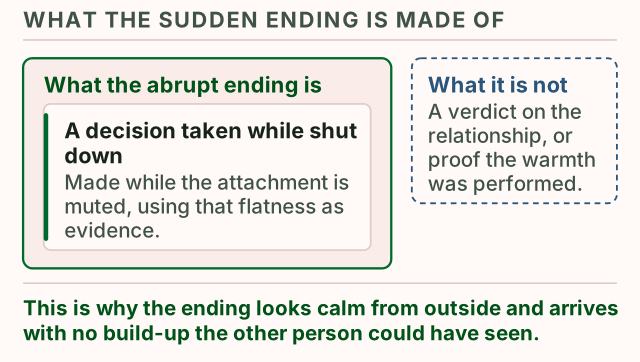
The short answer: because the decision tends to get made during a shutdown — a state in which distance feels like the only available relief — and a decision made there does not announce itself beforehand. The other person meets the conclusion without ever seeing the process, which is exactly what “sudden” means from the outside.
The fearful-avoidant version of this differs from a slow drift apart. In this pattern the system that reaches for a person and the system that defends against them fire close together, so the relationship can be visibly warm right up to the break. That is why the searches attached to this page — fearful avoidant impulsive breakup, fearful avoidant sudden breakup — describe endings that came after closeness, not after a long cold spell. The closeness itself can be what loads the switch; the mechanics of that pull-away live on the deactivating page.
From inside, the moment is rarely experienced as impulsive. Under enough pressure, ending things presents itself as clarity — the one move that makes the unbearable state stop. The reasons assemble around the exit, and they are not invented: every relationship supplies real ones. What makes this pattern distinct is the order. The relief comes first, and the reckoning with what was lost tends to come later, once the pressure is gone — which is why endings like these get followed by a reach back that confuses everyone, including the person doing the reaching.
None of this makes the ending less real, and none of it obliges anyone to treat a sudden breakup as a mistake waiting to be reversed. A decision made in a shutdown is still a decision someone is allowed to keep. The point of describing the mechanism is narrower: the abruptness says more about how this pattern handles pressure than about what the relationship was worth.
What is the ex likely doing?
Honestly: this page cannot tell you, and it will not pretend otherwise. What it can do is describe the behaviours people report around a fearful avoidant ex — without attaching predictions to any of them.
The report that recurs across these searches is inconsistency that continues after the ending. Contact stops, then resumes in a smaller format. For example: a story reply, a late-night message, a birthday text that carries more weight than its words. This is the same reach-and-retreat cycle the relationship ran on, now running on its aftermath. Distance lowers the pressure, the protective system stands down, and the pull toward the person returns — which produces contact — and the contact rebuilds the pressure, which produces retreat. Seen as a mechanism, the mixed signals stop being a riddle, even though they do not stop being painful.
Two specific versions keep coming up and are worth naming. Consider the offer to stay friends: often a request for the connection minus the exposure that set off the alarm — real affection through a channel that feels survivable. The block is the same move at the opposite volume: not a verdict, but a way of making the input stop entirely. Both are consistent with the same pattern, which is precisely why neither can be read as a prediction of what comes next.
Whether contact resumes at all — and what it means when it does — is the question this section’s largest page exists for: do fearful avoidants come back? answers it as a mechanism, not a promise. The abrupt total cut-off people call a “discard”, and the question of regret that follows it, has its own page at discard and regret.
What if you were the one who ended it?
Some readers arrive here from the other side of the sentence: i dumped a fearful avoidant — or they recognise the pattern in their own hands and typed nothing at all. Both get a plain paragraph here.
If you ended a relationship with someone who runs this pattern, expect the aftermath to be less linear than the ending. In practice, the accounts describe little visible protest at the time — and then contact later, when the pressure of the relationship is gone and the pull has room to return. Neither tells you what the relationship meant, and neither obliges you to respond. Your decision does not become provisional because the other person’s pattern makes their reaction arrive on a delay.
If you are the one who left — perhaps quickly, perhaps mid-shutdown — the experience people describe is a specific sequence: relief first, sometimes a long stretch of it, and then loss arriving once the nervous system settles and nothing is being asked of you any more. That sequence does not tell you whether the decision was wrong. Relief reports on what closeness was costing; the later ache reports on what the person meant. In this pattern those measurements come from different instruments, and the honest move is to read both before doing anything — not to treat whichever arrived last as the truth.
What this page will not do, in either direction, is supply tactics: no wording to win someone back, no silence calibrated to be missed. The searches exist; the levers do not work the way they are sold, and describing people as operable machinery is not what this guide is for.
Where each part is described
This page holds the shape of the arc. The detail lives on its own pages, and they do not repeat each other:
- How the breakup unfolds — the order people describe around these endings, before and after the break, written as a sequence rather than a calendar. No stages with numbers, no durations: the order is describable and the timing is not.
- Do they come back? — the question this section is built around, answered as a mechanism: why return contact is common in this pattern, what it does and does not signal, and how to read silence without turning it into either hope or a sentence. The honest version of “no contact” questions lives there too.
- The “discard” and regret — the sudden, total cut-off, being blocked, the fast new relationship, and what can and cannot honestly be said about regret afterwards.
- Deactivating — the shutdown mechanism underneath all of the above. If this section reads like the aftermath of something, that page describes the something.
Read together, they make one picture: an ending shaped by the same reach-and-retreat cycle that shaped the relationship — abrupt where the shutdown was, unfinished where the pull returned.
What this section does not do
Breakup content is where this niche takes advantage of people, so the limits are explicit.
- No timelines
- No day counts for missing you, returning, or regretting. Numbers like that circulate widely and trace back to nothing. A sequence can be described honestly; a schedule cannot, and someone counting days against an invented one gets hurt twice.
- No tactics
- Nothing here is designed to make an ex miss you, chase you, or come back — no scripts, no engineered silence. Those levers are sold everywhere and treat a person as a mechanism to operate. Describing the pattern is the whole product.
- No verdicts on either person
- The one who left is not labelled cold, and the one who was left is not told they dodged anything. A pattern is a description of tendencies, not a character reading — and readers of this section are often describing themselves.
- No predictions about your ex
- These pages describe what people report around this pattern. They cannot see your relationship, and any page claiming to know what a specific person will do next is guessing at your expense.
What we send
A short letter when this section grows
That did not go through. Nothing was saved and nothing was sent — try the address again, or write to us directly and we will add it by hand.
- It never tells you what you are, or what anybody else is.
- It carries no figures, because this guide publishes none.
- It arrives when a page changes, and stays quiet when none does.
Occasional emails about the fearful-avoidant pattern. No tactics, no timelines. Unsubscribe anytime.