People who search for what causes disorganized attachment are asking different questions with the same words. One is a question about a framework: how does the attachment literature say this pattern forms? The other is personal: why am I like this? This page answers the first question in the literature’s own words, and is honest about why it cannot answer the second — and where that second question actually belongs.
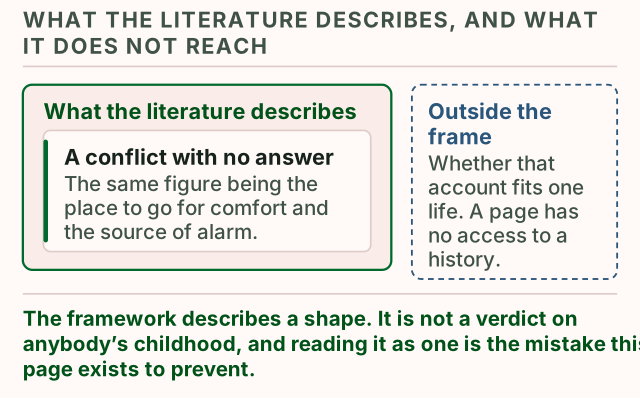
Disorganized attachment is described in the attachment literature as forming where the person a child depended on was both the source of comfort and, at times, the source of alarm — leaving no single strategy that worked. That is the framework’s answer to what causes disorganized attachment, and it is an account of a mechanism, not of a particular childhood.
It is the only page on this site about origins. The rest of the site — the description of the style itself, the cycle, the breakup pages — stays in the present tense on purpose. What a pattern looks like while it is running can be described from observation. Where it came from, for any specific person, cannot.
How does the literature describe the origin?
In the research tradition that produced the term, disorganized attachment is described as forming where the person a child depended on was both the place comfort came from and, at times, the source of alarm. The framework’s account turns on a conflict between opposing moves a child cannot help making: turning toward a caregiver when frightened, and turning away from whatever is frightening. When both moves point at the same person, neither one works, and no single strategy settles into place. That is the origin story the literature tells — an unresolvable approach–avoid conflict, sometimes summarized in the phrase fright without solution.
Some things about that account are worth stating precisely, because looser retellings blur them. First, “alarm” in this framework is not one kind of household. For example, one strand of the research is about frightened, threatening, and dissociative parental behavior in low-risk samples, not only about extreme ones. The literature’s descriptions include caregivers who were frightening, but also caregivers who were themselves frightened, absent in ways a child could not read, or unpredictable in their availability. The account is about what the child’s attachment system could not resolve, not a checklist of what the adults did.
Second, the framework describes the shape that carries forward, not a sentence that gets served. The adult version — wanting closeness and bracing against it at the same time — is read as the grown form of that early no-workable-strategy state. This is the same push–pull this site describes elsewhere as it appears in adult relationships; the signs and behaviors themselves live on their own page, described without reference to anyone’s childhood, because they can be observed without it.
Third, and this is the part retellings drop soonest: it is a framework. The account above is how a body of literature models the pattern’s formation in general. It is not a measuring instrument that can be pointed backward at one adult’s memory of one family and produce a finding. The framework itself does not claim that power, and neither does this page.
Why is “cause” the wrong word for an individual?
Because the framework describes how the pattern forms in general, and a general account cannot be run backwards over one person’s history to produce a finding. For a population-level model, “how does this pattern form” is a fair question, and the literature offers the answer above. For an individual, “what caused mine” is a different kind of question, and it breaks in several places.
The first break is memory. An adult asking the question is working from a partial record, assembled at the time by a child, and re-read since through everything that has happened after. Consider siblings from the same house: they can give incompatible accounts of it, each sincere. Whatever an article’s list of “causes” makes a reader recognize, recognition is not evidence.
The second break is direction. The framework runs forward: given these early conditions, this shape tends to follow. Reading it backward — I have this shape, therefore my childhood must have contained those conditions — is not a move the framework licenses. People arrive at the same adult pattern along different roads, and childhood is not the only thing on any of those roads.
The third break is what the answer would even do. Suppose a page could hand someone a verified cause. In practice, the pattern would still run the way it runs today, in the relationships it runs in. The part that responds to attention is the present-tense part — which is why this site’s pages about change work forward from the current pattern rather than backward toward an origin. An origin story can bring real relief, but establishing a true one, for one person, is careful work with another human being in the room. It is not something text can do.
None of this makes the question illegitimate. It makes it personal — and personal questions deserve better than a general-purpose answer pretending to be about you.
What this page will not do
Pages about origins drift into work that belongs to other people. These are the lines this one does not cross.
- Explain your history
- The framework's account is general. Your history is specific and only partly available even to you. A page that claims to bridge that gap is guessing while sounding certain.
- Assign blame to your parents
- The literature describes conditions, including caregivers who were themselves frightened or unsupported, not villains. Reading a description of a mechanism as an indictment of particular people is a use the framework does not support — and a burden this page will not hand anyone.
- Diagnose anything
- Disorganized attachment is a descriptive category from research, not a clinical diagnosis. Nothing here identifies a condition, and recognizing yourself in a description is not an assessment.
- Offer a therapeutic plan
- If reading about origins stirs something that needs working through, the right setting has a qualified person in it. This page routes there and stops; it does not simulate the first session.
What if the question is personal?
Then this page is the wrong instrument, and the right one has another person in it. Some readers arrive here idly curious about a framework. Others arrive because the question has weight — because reading the paragraphs above landed somewhere specific, or because the pattern is costing them something now and the why has started to feel urgent.
If that second description fits, the honest route is a conversation with a licensed mental-health professional: someone qualified to take an individual history, at a pace the person sets, with the standards of care that written content does not have. That is not a formality this page recites to cover itself. It is the actual difference between a general model and your answer — the general model is here, and your answer, if it can be assembled at all, gets assembled there.
There is no urgency implied in that. A reader who closes this tab and does nothing further has used the page correctly. But the question “why am I like this,” asked with real weight behind it, has a proper address, and it is not an article.
Where this page stops
This site describes a relational pattern as it appears in adult behavior. It does not diagnose, treat, or replace professional care, and its editors do not have clinical qualifications and do not imitate them. This page in particular summarizes how a research framework describes the pattern’s origins; it makes no claim about any reader’s history. For personal versions of the questions here, a licensed mental-health professional is the right resource.
Sources
The account summarized above comes from the attachment-research tradition: the work of Mary Main and Judith Solomon, who described the disorganized category in the edited volume on attachment in the preschool years, and of Erik Hesse and Mary Main, whose phrase fright without solution is a condensation of the mechanism this page paraphrases. The full list of the literature this site draws on, along with how its factual claims are checked, lives on the sources page. Where this page’s wording and the literature’s diverge, the literature wins, and corrections are welcome.
What we send
One letter on how the pattern runs now
That did not go through. Nothing was saved and nothing was sent — try the address again, or write to us directly and we will add it by hand.
- It never tells you what you are, or what anybody else is.
- It carries no figures, because this guide publishes none.
- It arrives when a page changes, and stays quiet when none does.
A plain-language walkthrough of the reach-then-withdraw pattern. No promises of outcomes. Unsubscribe anytime.