
Type “fearful avoidant female” into a search bar and the suggestions fill with its mirror image: fearful-avoidant men, dating a fearful-avoidant woman, how to love a fearful-avoidant man. The searches split neatly by gender. The pattern they are asking about does not. This page takes the gendered questions seriously as questions — what is the person asking, and what are they actually seeing — without pretending the answers come in a his-and-hers version.
Fearful avoidant female is a search phrase rather than a separate pattern: it points at a woman whose close relationships run the fearful-avoidant cycle — closeness wanted, closeness defended against, and distance arriving after the good stretch rather than after the bad one. The male-phrased searches point at the same thing.
Why do the searches split by gender?
The searches split because nobody is dating a concept. The person typing has a specific man or a specific woman in mind, and they phrase the question the way they would describe the situation to a friend: he went quiet, she pulled away, what does it mean when a woman does this. Adding a gender to the search is a way of asking about my person rather than about attachment in general.
There is a second reason, and it does more work than the first. Gendered scripts assign a default meaning to distance before any pattern gets considered. For example, a man who retreats after a close weekend can be filed under men needing space; the same retreat from a woman breaks the script that says women want closeness, so it reads as something being wrong. The behaviour is identical. The explanation people reach for is not, and that gap is what sends them searching with a gender attached.
None of this means the pattern itself varies by gender. It means the reading of the pattern varies, because it lands on different expectations. That distinction runs through the rest of this page.
What do people ask about fearful-avoidant men?
The questions about fearful-avoidant men cluster around disappearance and love. Why did he withdraw after things got close. What makes a fearful-avoidant man fall in love. How do you date a man who is warm in person and silent for days afterwards. The asker has seen real closeness — that part is what makes the silence confusing — and wants to know whether the closeness or the silence is the truth.
The honest answer is that both are, in sequence. Fearful-avoidant is a description of a person in whom the wish for closeness and the defence against it run at the same time: the good stretch is real, and it is also what raises the internal pressure that the distance then relieves. The mechanics of that retreat are described in what deactivating looks like; nothing about them is male. The attachment literature — including the four-category model of adult attachment, where the fearful-avoidant label was defined — describes the pattern without a gender attached, and so does this site.
What the gendered script does here is provide cover. A man’s withdrawal has a ready-made explanation — work, stress, men not talking about feelings — so the cyclical shape can go unnamed for a long time. In practice, partners describe noticing the pattern only when the timing gives it away: the distance keeps arriving after the closeness, not after conflict. The other cost of the script is on the loud side of the pattern. Consider a defence that shows up as irritability rather than silence: it gets read as temper, and the fear underneath it goes unexamined by everyone, including him.
What do people ask about fearful-avoidant women?
The questions about fearful-avoidant women lean toward decoding. What does fearful-avoidant female mean. Why is she hot and cold. How to date a fearful-avoidant woman, how to love one, whether the push-away means it is over. The word that recurs in these searches is “confusing”, and the confusion has a structure: warmth that was unmistakably real, followed by a withdrawal that arrives without an argument to explain it.
Fearful-avoidant women are described by the same account given above, with the pronoun changed. Closeness is wanted and defended against; the defence engages after the closeness, not instead of it. The signs of the pattern — the timing of distance, the discomfort with being fully seen, the retreat that follows the best moments — are written without a gender because they present without one.
The script works differently here, though. Because women are expected to want and tend closeness, the script has no neutral explanation on offer for a woman’s withdrawal. What it offers instead is lost interest, manipulation, testing. Some of the search phrasing carries that reading already — “games”, “leading me on” — and part of what the asker needs is not a decoder for women but a name for a cycle that has nothing to do with games. Whether distance is a test or a defence is a real question with a non-gendered answer, and the practical side of it is covered in dating a fearful-avoidant partner.
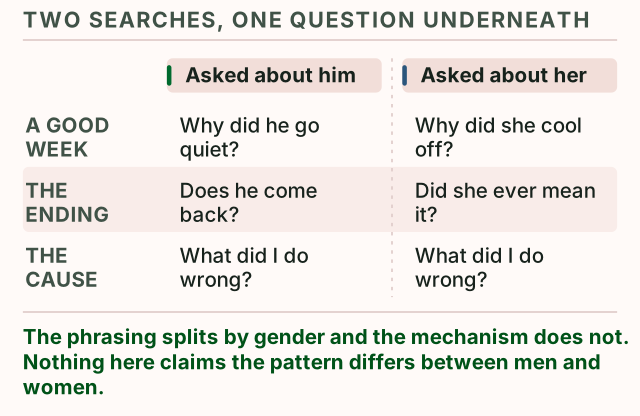
What is the same for men and women?
Strip the pronouns from the two sections above and they collapse into one description. The sequence people report — closeness, then pressure, then distance, then return — is the subject of this whole site, and it does not change shape at the gender line. The questions behind the gendered searches are the same questions: is the warmth real, what does the silence mean, is this something I did.
The answers do not change either. The warmth is real. The silence is the defence half of the pattern doing its work, and it says more about how closeness itself is processed than about the partner’s worth. And the pattern predates the relationship; a partner can set it off, but they did not install it.
That is why this site’s pages are written without gendered versions. A page on the style that needed a men’s edition and a women’s edition would be claiming a difference it cannot show. The useful split is not men versus women; it is pattern versus interpretation. The pattern is one thing. The interpretations are where gender does its distorting work, in both directions.
What this page does not claim
The gendered corner of this topic is crowded with confident generalizations, and this page’s main job is to decline to add to them.
Claims we are not making
These are the statements this page is structurally unable to stand behind, and so refuses to make.
- That the pattern differs by gender
- We have no sourced basis for saying men with this pattern behave one way and women another, so we do not say it. Every behavioural description on this site is written without a pronoun for that reason, not as a stylistic choice.
- That gender explains your specific person
- "He's avoidant because men are like that" and "she's playing games because women do that" are both interpretations borrowed from a script, not observations of a person. Neither survives contact with the actual cycle, which runs on closeness, not on gender.
- That there is a technique for a fearful-avoidant man or woman
- Searches like "how to make him chase you" treat the pattern as a lock with a gendered key. We do not describe tactics, because the pattern is not a lever to be pulled; it is a way of processing closeness that belongs to the person who carries it.
- That recognising the pattern is a diagnosis
- Fearful-avoidant is a descriptive frame, not a clinical category, and nothing here can tell you whether it is the right frame for a particular man or woman. That question belongs to the person themselves, with a professional if they want one.
What we do stand behind
- One description, carefully made
- The pattern as this site describes it — closeness and defence engaging together — is written to be recognisable regardless of who is living it.
- Taking the interpretation gap seriously
- The way identical behaviour gets read differently in men and women is real, worth naming, and the closest thing this topic has to a genuine gender difference we can point at.
The absence of gendered claims is not caution for its own sake. Every generalization about fearful-avoidant men or women that circulates becomes a lens someone uses on a real partner, and a wrong lens on this pattern is expensive: it turns a defence into an insult, or a cycle into a character verdict. The description that actually helps is the one that fits the person, and that one never comes with a pronoun attached.
What we send
A note when something new is published here
That did not go through. Nothing was saved and nothing was sent — try the address again, or write to us directly and we will add it by hand.
- It never tells you what you are, or what anybody else is.
- It carries no figures, because this guide publishes none.
- It arrives when a page changes, and stays quiet when none does.
No spam, ever. Unsubscribe anytime.