
People arrive at fearful avoidant attachment signs holding one of two puzzles. Either a partner’s behaviour has stopped adding up — warm on Sunday, unreachable by Wednesday, back again with no explanation — or their own has, and the search bar is the first place they have said it out loud. This page describes the signs in behavioural terms, for both readers, without turning the list into a verdict.
Fearful avoidant attachment signs are the behaviours in which the pull toward closeness and the push away from it show up in the same person, toward the same partner: warmth followed by an unexplained retreat, reassurance asked for and then deflected, connection tested instead of asked about.
A note before the list. Every behaviour below has other explanations: stress, grief, a bad match, a person who has simply changed their mind. What makes any of it a sign of the fearful-avoidant pattern is not intensity but structure — the pull toward closeness and the push away from it arriving together, again and again, with the same person. The pattern is described in full on the main style page; this page is about how it looks.
What are the signs of fearful-avoidant attachment?
The signs cluster around a single mechanism: the wish for closeness and the defence against it switching on at the same time. Everything on this list is a version of that collision, seen from a different angle.
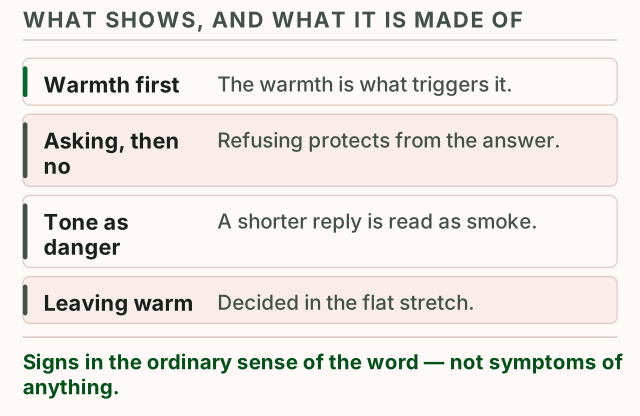
- Warmth followed by distance that nothing visible explains. The retreat follows the good moment, not the bad one — after the open conversation, the settled weekend, the step forward.
- Reassurance wanted and refused in the same exchange. The question gets asked — “are we okay?” — and the answer, when it comes, is deflected, doubted, or tested rather than taken in.
- Small changes read as danger. A shorter reply, a flat tone, a delayed response: each one lands as evidence that something has gone wrong, and the reaction arrives before the check.
- Closeness pursued, then treated as a threat once it arrives. The chase feels safe because the distance is still there; the arrival removes the distance, and the alarm goes off.
- Connection tested instead of asked about. Silence to see who reaches out first, a pulled-back weekend to see if it gets noticed — questions posed as behaviour rather than words.
- Trust that collapses on small evidence and rebuilds slowly. Good treatment is filed provisionally, as if the catch has simply not been found yet.
- Relationships ended while the attachment is still alive. The leaving is real and so is the wanting; ending things becomes the only way to make the internal noise stop.
- Both conflict styles in one person. Sometimes flooded and loud, sometimes shut down and gone — which one appears can depend on how close the relationship had just become.
No single line on this list identifies anyone. The recognisable thing is the shape: approach and withdrawal running in the same person, toward the same partner, inside the same week.
A useful cross-check is time. Anyone can have a withdrawn month after a hard stretch, and anyone can want space after an argument. In those cases the distance has a cause that both people can name, and it fades as the cause does. In the fearful-avoidant pattern the distance follows closeness itself, resists explanation even from the person taking it, and alternates rather than resolves. If you can point at what the retreat is about, you are probably not looking at this pattern; if the retreat keeps arriving precisely when nothing is wrong, you might be.
What does fearful-avoidant attachment feel like from the inside?
From the inside, the pattern feels like wanting two opposite things with equal force and no way to choose. Closeness is genuinely wanted — this is not indifference wearing a mask — and at the moment it becomes available, a second system fires that treats the same closeness as exposure. People describe it as bracing, flinching, a need to get out of the room that arrives without a story attached.
Calm is its own problem. A stretch where nothing is wrong does not read as safety; it reads as the quiet before something. In practice, people describe scanning a settled relationship for the thing they must have missed, and feeling more at ease once a problem finally appears, because a problem is at least legible.
The reassurance loop is its own experience worth naming. The need for confirmation is real and strong — and the confirmation, once given, cannot be absorbed. Consider a partner who says exactly the right thing: it bounces — maybe they said it to end the conversation, maybe they meant it in the moment but not in general. So the question gets asked again, sideways this time, or gets converted into a test. From inside, this does not feel like doubting the partner; it feels like being unable to find a surface the reassurance will stick to.
Distance, when it is finally taken, brings relief and loss at the same time — and that double feeling is itself part of the signature. The relief says the retreat was necessary; the loss says the attachment never went anywhere. Both are telling the truth. What switches this sequence on, and what the shutdown looks like once it runs, is the territory of the cycle, which this site treats as the mechanism behind every sign on this page.
What does the pattern look like from the outside?
From the outside, the same mechanism reads as inconsistency. A partner sees warmth that switches off without an argument to point to, plans that dissolve after the best week the relationship has had, and a person who reaches out and then does not answer the reach they invited. The report that recurs is not “they are cold” but “I can’t predict them.”
The tests are the part outsiders feel most directly. For example: a silence that is secretly a question, a withdrawal staged to see whether it gets noticed — from the receiving end these are indistinguishable from fading interest, which is why partners end up searching for the difference between testing and love. The honest answer is that the behaviour alone does not say; the surrounding pattern does.
The outside view also depends on volume. The same collision can run loudly — protest, conflict, visible push and pull — or so quietly that the partner only registers a slow ambient retreat. Both readings show up in search as their own labels, and the difference between them is described on the quiet and loud page. The mechanism underneath does not change with the volume.
What traits do people report, and what do those traits describe?
Searches for “fearful avoidant traits” and “fearful avoidant characteristics” return adjectives: hot and cold, intense, guarded, self-sabotaging, hard to read. Adjectives are how the pattern gets talked about, but each one is standing in for a behaviour, and the behaviour is the useful part.
“Hot and cold” is the alternation itself named as a temperature — the approach phase and the retreat phase seen from outside and compressed into one word. “Intense” tends to describe the approach half: fast closeness, deep attention, the feeling of being fully seen early. “Guarded” describes the defence half of the same person, and the whiplash between the two is what makes the word feel inadequate. “Hard to read” is what it is like to receive both halves without knowing there is a mechanism producing them.
“Self-sabotaging” deserves its own sentence, because it is the label people apply to themselves with the most force. What it describes, behaviourally, is the retreat arriving at the moment things become good — which from inside the pattern is not sabotage but self-protection aimed at the wrong target. Treating it as a character flaw describes the cost; it does not describe the mechanism.
The general rule for all of these: when a trait word appears, translate it back into the behaviour it summarises. The adjective invites judgement; the behaviour invites recognition.
Signs vs symptoms: why we use one word and not the other
Some of the searches that lead here are phrased as “disorganized attachment symptoms,” and the word choice matters more than it looks. “Symptoms” is a medical word: it implies an underlying condition, a threshold, and a diagnosis waiting at the end of the list. An attachment pattern is none of those things. In the attachment literature, including Mikulincer and Shaver’s open-access review of attachment in adults, it is a description of how a person handles closeness — a summary of behaviour, not a marker of illness.
That is why this page says “signs” and means it loosely: things people notice and recognise, in themselves or in a partner. There is no score, no cut-off, and no count of items that turns recognition into a classification. Recognising the pattern is useful because it replaces “something is wrong with me” or “they are playing games” with a mechanism that can actually be looked at. It is not useful as a self-administered result.
The distinction also protects the reader in the other direction. Some experiences that bring people to this search — dissociation, panic, a history that is hard to look at — belong in a conversation with a professional, not in a list on a website. Keeping “symptoms” out of our vocabulary is how this site keeps that line visible.
What this page doesn't do
- No checklists with a score
- There is no count of items that turns reading into a result. A list of behaviours read as a verdict does more harm than the confusion it was meant to settle.
- No quiz
- A quiz would imply a threshold, and a threshold would imply a classification. This site describes a pattern; it does not sort readers into it.
- No diagnosis by comparison
- We do not map these behaviours onto clinical conditions or argue about overlap. That work belongs to a clinician sitting with a specific person.
- No verdicts on partners
- Recognising the pattern in someone else explains behaviour; it does not license labelling them, and it does not answer whether to stay.
Where this page stops
This page describes behaviour that people recognise and report; it cannot see any single reader’s situation. An attachment pattern is not a diagnosis, and nothing here can distinguish a pattern of relating from a clinical condition that deserves its own attention — including the experiences that sometimes drive this search, such as feeling unsafe with a partner or finding the past intruding on the present. If what you recognised on this page feels bigger than a relationship habit, the right person to bring it to is a therapist or a doctor — someone who can look at the whole of your situation, which a description cannot do.
What we send
The signs, sorted into one letter
That did not go through. Nothing was saved and nothing was sent — try the address again, or write to us directly and we will add it by hand.
- It never tells you what you are, or what anybody else is.
- It carries no figures, because this guide publishes none.
- It arrives when a page changes, and stays quiet when none does.
No schedule, no sequence, no course. One link in every letter takes you off the list for good.