The search for a fearful avoidant discard tends to begin from the same scene: a relationship that felt real, sometimes unusually good in its final stretch, ended abruptly — short message, sudden block, or plain silence — with no explanation that could be used to make sense of it. The word “discard” is what the internet has settled on for that scene, and this page takes the word seriously without endorsing what it implies.
Here, the cut-off itself is described first, from both sides — what it looks like from the receiving end and what it is from inside the pattern, including what a block means and does not mean. Then the question underneath every version of this search — do they regret it? — gets the honest treatment: what can be said about fearful-avoidant breakup regret, what cannot, and why the confident answers found elsewhere should not be trusted. The wider arc of a fearful-avoidant ending is mapped on the breakup overview.
A fearful avoidant discard is the abrupt, total, unexplained cut-off that ends some fearful-avoidant relationships — an ending that lands after closeness rather than after conflict, which is what makes it feel unprovoked.
What do people mean by a fearful-avoidant discard?
As the word is used in search, a discard is an ending with a recognisable shape: it is sudden, it is total, and it is unexplained in any way the other person can work with. Contact does not taper — it stops. For example: a block across every channel, a single flat message, or simply a silence that never breaks. And it tends to land after closeness, not after conflict, which is the detail that makes it feel unprovoked.
The word itself deserves a moment of honesty. “Discard” is a word that did not come from the attachment literature; it arrived from forums describing calculated, exploitative relationships, where it names a deliberate act of disposal — using a person up and throwing them away. Carried over to a fearful-avoidant ending, the word keeps the pain and imports the intent. This page uses it because it is what people type, but it describes the event without assuming the calculation: what the receiving end experiences as a disposal is, from inside this pattern, often something else — described next.
None of this makes the experience of the person left behind smaller. Being cut off without usable reasons is disorienting in a specific way: there is nothing to argue with, nothing to repair, and no version of events to close the file on. The dumpee in this scenario is often left doing the work of both people — writing the explanation the other person never gave.
What is the cut-off from inside?
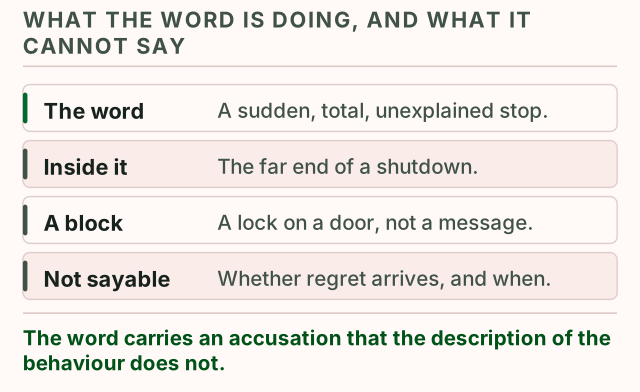
From inside the pattern, the sudden ending is the far end of a shutdown — deactivation carried all the way to its conclusion. The fearful-avoidant system runs a wish for closeness and a defence against it at the same time; when the defence takes over, feeling for the partner gets muted, contact starts to register as pressure, and exit starts to register as air. The mechanics of that state have their own page. What turns a shutdown into an ending is a decision made while the state is running — while the feelings are muted and the relief of distance is doing the arguing.
That is why the exit looks impulsive and out of scale. The decision was real, but it was made inside a state that alters what the relationship feels like, using reasons assembled on the way out. In practice, that is also why the explanations, when any are given, sound thin — “I’m not ready,” “you deserve better,” “I can’t do this” — sentences that describe the state without explaining it.
Understood this way, the abruptness reads differently. The cut-off, in these accounts, is not the endpoint of a long private plan, and it is not evidence that the feelings beforehand were performed. It is what it looks like when a person exits a relationship at the moment they are least able to feel it. That does not make it acceptable to be on the receiving end of, and this page does not ask anyone to excuse it — only to identify it accurately, because everything about the regret question depends on what the ending actually was. How the aftermath tends to unfold from here, on the leaver’s side, is described step by step on the stages page.
What does it mean if a fearful avoidant blocked you?
“Fearful avoidant blocked me” is its own search for a reason: a block feels like a message, and the message it seems to carry is hatred, or erasure, or proof you never mattered. What can honestly be said is this: a block is an act with several describable motivations, and from outside they look identical.
Consider noise reduction: while the shutdown runs, every channel you could appear in is a source of alarm, and closing the channels quiets the alarm. Another points the opposite way — the block as a guard against the blocker’s own impulses. A person who knows their pattern reverses knows that the muted feelings may come back, and that at some low midnight they will be the one reaching out; blocking makes their own reach-back harder. Still another is plain conflict avoidance: the block ends the conversation without having it.
Notice what none of these versions carries: a measured verdict about your worth. That does not mean the kinder readings are the true ones in your case — it means the act itself does not say. A block tells you the door is closed; it does not tell you why, and it does not tell you for how long. People describe blocks that lasted forever and blocks that quietly lifted, and no outside sign distinguishes them in advance.
Do fearful avoidants regret the breakup — and what can honestly be said about it?
Here is where this page refuses to do what other pages on fearful avoidant regret tend to do. You will have read that avoidant leavers always come to regret it, or that regret arrives on a schedule, in stages, at a predictable week. None of that is knowable. No measured data on fearful-avoidant breakup regret exists for a page like this to cite, and the confident figures in circulation are copied between websites, not drawn from anywhere. This site does not print numbers it cannot source, so what follows is only what can be described.
Regret, where people report it, has a describable mechanism. The decision was made while feeling was muted; the muting is a state, and states pass. When distance has done its work and the alarm settles, what was muted can come back — and it comes back aimed at a person who is no longer there. What returns first, in these accounts, is not “I made a mistake” but the feeling itself: missing the person, replaying the ending, reaching for the phone. Whether that gets acted on is a separate event — regret and return are different things, and the gap between them is where the come-back question lives.
And the other half of honesty: some people who leave this way do not describe regret at all. For some, the ending brings a relief that holds, or a settled sadness that never turns into reaching back. Both outcomes are real. A page that promises you the regret of the person who left is not describing them — it is medicating you, and this page will not do that either.
What we send
After the cut-off: one honest letter
That did not go through. Nothing was saved and nothing was sent — try the address again, or write to us directly and we will add it by hand.
- It never tells you what you are, or what anybody else is.
- It carries no figures, because this guide publishes none.
- It arrives when a page changes, and stays quiet when none does.
A short email walking through the reach-out, push-away loop. No spam, unsubscribe anytime.
What about a new relationship soon after?
A fearful avoidant rebound — a new relationship appearing quickly after the abrupt ending — is one of the harder things to watch from the outside, because it seems to settle every question at once: they’re fine, you were replaceable, none of it was real. What can be described says less than that.
A relationship begun while shut down starts under specific conditions. The new person arrives with none of the accumulated closeness that set off the alarm; early-stage contact is exactly the register the pattern finds breathable — warm, light, and shallow. Nothing about entering one requires the previous attachment to have been processed, resolved, or even fully felt yet. So a fast new relationship is evidence that the person has started one, and nothing more. It does not measure what you were, and it does not predict what happens when the new closeness deepens and the same system meets the same threshold.
Searches for “rebound stages” want a schedule for that unravelling. No stages are printed here, for the same reason no regret timeline is: a numbered sequence with predicted durations would be invented, and its confidence would be the only thing about it that felt true. New relationships that start this way sometimes end the way yours did, and sometimes do not. Anyone claiming to know which, from outside, on a schedule, is guessing at you.
What this page doesn't offer
- No regret timeline
- No week counts, no percentages, no 'stages of avoidant regret.' No measured data on this exists to cite, and the schedules published elsewhere are invented and recycled.
- No tactics
- Nothing here is a method for making a person regret leaving or come back. Regret is not operated from outside, and content promising otherwise sells false control over another mind.
- No verdict on intent
- This page cannot tell you whether your ending was a shutdown, a settled decision, or something else. It describes a pattern; it cannot see your relationship.
- No character ruling
- The person who left is not sorted here into cruel or blameless, and neither is the person left. A pattern description is not a moral verdict on either side.
Where this page stops
This page describes a behavioural pattern as people recognise and report it. It cannot see any particular relationship, and it cannot tell a pattern of relating apart from a clinical condition that deserves attention in its own right — an attachment style is a description, not a diagnosis, of the person who left or the person left behind. Abrupt endings can also land on the receiving side with a weight that outlasts the relationship: if the aftermath feels larger than a breakup — for you or for the person who ended it — that weight belongs with a therapist or a doctor, who can respond to what actually happened rather than to a pattern.