
People search for fearful avoidant breakup stages from both ends of the same event. Some were left — often suddenly, often right after things seemed close — and want to know what is happening on the other side of the silence. Some did the leaving and are watching their own feelings arrive in the wrong order: certainty first, grief later. Both are looking at the same sequence from different seats, and this page walks through it once, in order.
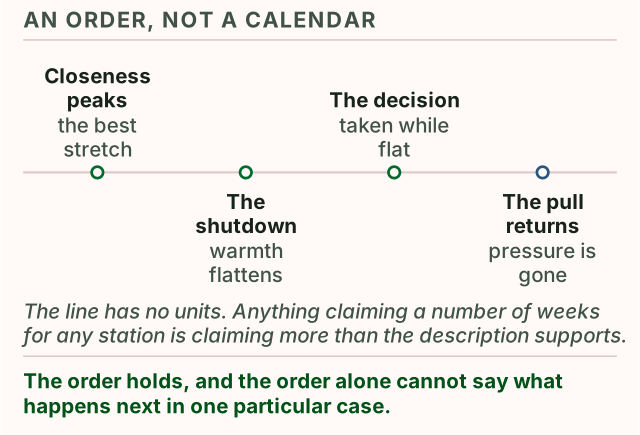
Fearful avoidant breakup stages are an order rather than a calendar: closeness escalates, the protective shutdown arrives, the decision gets made inside it, relief follows the ending, and the pull toward the person returns later.
The sequence sits inside the larger pattern this site describes — a system that wants closeness and defends against it at the same time. A breakup is what happens when that conflict stops cycling and resolves, temporarily, in favour of the exit. The breakup hub maps the whole territory; this page covers the chronology only. Whether the person returns is a different question with its own page.
Why “stages” and not a timeline?
Because stages can be described honestly and a timeline cannot. The order in which things tend to happen in a fearful-avoidant breakup is remarkably consistent across the accounts people give — consistent enough to be worth writing down. The pace is not. How long any phase lasts varies with the length of the relationship, how it ended, whether contact continued, and what each person’s life looks like afterwards. No measured durations exist to cite in the attachment literature, so none appear here.
This matters more than it sounds like it should, because timeline content is what dominates this search. Pages that assign weeks to each stage are not summarising evidence; they are decorating a sequence with invented precision, and the decoration is the part that gets quoted. Treat any specific interval you read elsewhere as a guess wearing a lab coat.
So: a sequence, not a calendar. What follows is the order, one stage at a time — including the stretch before the breakup, which is where the ending actually begins.
What happens before the breakup?
Fearful-avoidant breakups rarely begin with dissatisfaction. They begin with closeness. The stretch before the ending is very often a good one — more intimacy, firmer plans, the relationship becoming more real and harder to exit. In this pattern, that is precisely the problem: closeness raises both the pull toward the person and the sense of exposure, and when exposure wins, the system starts looking for air.
From outside, this stage is nearly invisible, which is why partners describe the breakup as coming out of nowhere. In hindsight, people sometimes recall small tells. For example: a flatter tone after an especially warm weekend, plans that stopped being proposed, a slight step back in language. At the time, these read as mood. What they often were was the beginning of a shutdown, arriving on schedule after intimacy rather than after conflict.
A note on the search phrase “fearful avoidant breakup stages female,” since it brings people here: the accounts do not support a separate female sequence. The order described on this page shows up in the same shape regardless of who is running it; what varies is presentation, and that varies person to person far more than it varies by gender.
The person inside it may not be able to narrate this stage either. The discomfort is real but unexplained, and the explanations — doubts about compatibility, a list of small grievances, a sudden certainty that something is missing — tend to be assembled after the feeling, not before it.
The shutdown
The shutdown is the stage this site describes in full on the deactivating page: the attachment system’s volume gets turned down. The felt need for the partner drops, contact starts registering as pressure, and distance starts registering as relief. Warmth goes flat, replies thin out, and the personal register drops out of the relationship while the logistics of it continue.
What makes the shutdown matter for a breakup is what it does to perception. While it runs, the relationship is being evaluated by a person who currently cannot feel most of what they feel about it. For example, the muted attachment reads as absence of love, and the flatness reads as proof. The partner’s entirely reasonable response to the withdrawal — asking what is wrong, seeking reassurance — reads as more pressure, and confirms the case being quietly built.
Not every shutdown ends in a breakup; a shutdown can resolve back into the cycle without one. What turns one into an ending is a conclusion getting attached to the state while it runs — which is the next stage.
The decision
The decision to leave tends to be made inside the shutdown, and this is the single most important fact about it. It is made while the attachment is muted, using the flatness as evidence, by a person who at that moment genuinely cannot locate their feelings for their partner. From inside, the reasoning feels clear, even overdue. From outside, it looks inexplicable, because the evidence being cited — “I don’t feel the way I should” — describes the state, not the relationship.
This is why the ending so often arrives abruptly, with a strange calm, and why the stated reasons can feel thin or interchangeable. Often the person is not ending a relationship they have weighed and found wanting; they are ending the pressure of the situation, and the relationship is what the pressure was attached to. The abrupt version of this exit — the one partners describe as being suddenly dropped — and the regret that sometimes follows it have their own page.
For the person who was left, the practical takeaway is not comforting but is clarifying: the verdict delivered at this stage was produced by the shutdown, and it is not a reliable account of what you were to them. It is also not, on its own, evidence they will return. It is simply a decision made in a particular state, and states pass.
Relief, and what comes after it
The stage after the breakup is the one that hurts partners most to watch: the person who left appears fine. Lighter, even. This is not performance, and it is not proof the relationship meant nothing. Relief is the honest, predictable result of removing the thing the system was defending against. The pressure is gone; of course it feels like air.
Relief does double duty in this stage. It feels good, and it feels like confirmation — “I feel better, so leaving was right.” Social life often expands here. Some people throw themselves into work, or into someone new; the rebound version of this stage is covered alongside discard and regret. The person left behind, meanwhile, is grieving on the normal schedule, which creates the cruel asymmetry this stage is known for: one person at their worst while the other looks at their best.
The word “looks” is doing work in that sentence. Relief is a stage, not an outcome. It lasts as long as the distance keeps feeling like safety rather than like loss — and in this pattern, distance does not keep feeling like safety forever.
When does the pull come back?
The final stage is the one that separates this pattern from a settled, considered ending: with enough distance, the attachment that was muted becomes audible again. The alarm is gone, the pressure is gone, and what remains is the other half of the system — the half that wanted the person. People describe missing the ex sharply and unexpectedly, replaying the relationship, questioning the story they told themselves at the decision stage, sometimes checking on the person from a distance.
What this stage produces on the outside varies enormously. Sometimes nothing visible: the pull is felt and not acted on, and the ending holds. Sometimes a small, deniable reach-back — a reply to a story, a message on a birthday — that carries none of the explanation the other person is waiting for. Sometimes a fuller return. Which of these happens, and whether a return would even be wanted, is the subject of the do-they-come-back page; this page’s job ends with the observation that the pull returning is part of the sequence, not an anomaly in it.
One caution against reading this stage as a promise. The pull coming back is not the person coming back, and it is not the relationship having been secretly fine. It is the same approach–withdraw mechanism that ran during the relationship, now running across the breakup.
What does breaking up with a fearful avoidant look like from the other side?
Everything above also runs when the roles are reversed — when you ended it. The accounts people give of leaving a fearful-avoidant partner describe the same stages refracted. Consider a partner who seemed almost relieved at the ending, or went silent without protest, and then — later, unexplained — resurfaced warm, as if the sequence had been running quietly the whole time.
From this seat, it is worth naming the following. First, a quiet or flat reaction to being broken up with is not evidence the relationship did not matter; a shutdown can be a response to the threat of loss as well as to closeness, and the grief in this pattern often runs late and in private. Second, the resurfacing — if it comes — belongs to the last stage above, and it tends to arrive without the conversation you may want from it. What it means, and what it does not, is covered on the breakup hub and the pages linked from it.
What this page doesn't offer
- No calendar
- No stage here comes with a duration. No measured intervals for these phases exist to cite, and attaching weeks or months to them would be invention presented as data.
- No predictions
- The sequence describes an order that recurs in people's accounts, not a script any one person must follow. This page cannot tell you which stage your ex is in or what they will do next.
- No tactics
- Nothing here is a method for steering someone through these stages, speeding one up, or engineering the return of the pull. The pattern is not operated from outside.
- No advice to stay or go
- Whether a relationship with this pattern is right for you is not a question a page can answer, and this one does not try.
What we send
The breakup sequence, in one letter
That did not go through. Nothing was saved and nothing was sent — try the address again, or write to us directly and we will add it by hand.
- It never tells you what you are, or what anybody else is.
- It carries no figures, because this guide publishes none.
- It arrives when a page changes, and stays quiet when none does.
One email walking through the stages above and what each one does and does not mean. No spam, unsubscribe anytime.