
The question “do fearful avoidants come back” tends to be asked by someone holding two pieces of evidence that do not fit together: an ending that felt abrupt, and a relationship that did not feel over. The person who left ran hot and cold the whole way through, reached out and pulled away, wanted closeness and fled it — and then the leaving itself had the same texture as the pulling away. So the question underneath the question is: was that an ending, or another swing?
This page answers as honestly as the material allows. It describes what tends to bring contact back after a fearful-avoidant breakup, what a returning ex looks like, what a finished ending looks like, and how silence lands inside this pattern. It does not print a timeline, and the last section explains why. How the breakup itself tends to unfold, from decision to aftermath, is a separate question with its own page; the wider picture of this pattern after a relationship ends lives on the breakup hub.
A fearful-avoidant return is the same push–pull cycle running after the ending: the breakup removes the closeness that was raising the alarm, and once the alarm settles the muted attachment becomes audible again.
Do fearful avoidants come back?
Some do. Some do not. Anyone offering more precision than that is describing their audience’s hopes, not the pattern.
What can be said with a straight face is this: the fearful-avoidant pattern does not stop running at the breakup. The push–pull that shaped the relationship — closeness raising alarm, distance restoring the wish for closeness — keeps operating on the memory of the relationship too. That is why exes in this pattern are famous for reappearing: the same mechanism that made the person retreat from intimacy makes the intimacy attractive again once it is safely gone. A breakup, from inside this pattern, can function as the largest deactivation of all — and deactivation is a state that can reverse.
But “the pattern permits returns” is not the same as “your person will return.” Whether a specific ex comes back depends on things no page can see: whether the ending was an escape or a decision, what the relationship had come to mean, what else is happening in their life, and what happens to the alarm once the distance is real. The honest answer to “will a fearful avoidant come back” is that the door tends to stay ajar longer than partners expect — and that an ajar door is not a promise anyone is walking back through it.
What makes a fearful avoidant come back?
The pressure ending, and then the attachment underneath it becoming audible again. The mechanism is worth understanding, because it explains both the returns and the strange shape they take.
During the relationship, closeness itself was the pressure. The breakup removes it. For a while, that removal reads as relief — the alarm that had been running finally quiets, and the person may feel lighter, surer, freer than they felt in months. This is the stretch in which an ex seems to have moved on at implausible speed, and it is real, but it is not the whole event.
Underneath the relief, the attachment was muted, not deleted. When the pressure stays gone, the muting has less work to do, and what was underneath becomes audible again: missing the person, replaying the relationship, wondering. If that pull gets strong enough — or if something raises the ex’s presence suddenly, a photo, a mutual friend, a hard week — the reach happens. It tends not to look like a conversation about the relationship. For example: a reply to something public, a question that did not need asking, a message about a shared show. Small, deniable, retractable: the reach is built so that it can be disowned if it is not received warmly.
And the same mechanism describes what stops a restart. Pressure keeps the alarm running: messages awaiting answers, visible hurt, pursuit — all of it registers as more of the thing that was fled, and while it continues the muted attachment stays muted. A decision does the same from the other side: if the person concluded, during the shutdown or after it, that the relationship itself was the problem, the settling of the alarm does not bring the pull back — it confirms the exit. And sometimes nothing dramatic happens at all; the quiet simply becomes the new state, and the thread closes without an announcement.
How can you tell if a fearful avoidant ex wants you back?
None of the following is proof, and any one of them alone has ordinary explanations. What partners describe, when contact does eventually restart, is a cluster that looked like this in the weeks before:
Small, deniable openers. A reaction to a story, a reply to something public, a question with an obvious answer. The tell is that the message did not need to exist — it is a door being touched, not opened.
Watching from a distance. Your posts get seen quickly, mutual friends mention being asked about you, your life is visibly being tracked. The attachment is monitoring what it will not approach.
A thread kept deliberately unresolved. Consider belongings that never quite get exchanged, a practical matter that stays open, a subscription still shared. Closing these things ends the last legitimate reason to make contact, and the person keeps not closing them.
The approach–retreat pulse. A warm message, then silence for days. A good conversation, then withdrawal. This is the relationship’s cycle running at long range — frustrating to receive, but structurally it is the signature of an attachment still active, because a finished person does not need to retreat from you.
Reaction to your distance. When you go quiet, something shifts — a check-in arrives, the watching intensifies. Distance from someone still attached produces movement; distance from someone finished produces nothing.
Read the cluster, not the item. And read it for what it actually shows: the pull returning. It does not show a decision, an apology, or a changed pattern — a reach-back is the cycle turning, and the cycle that brought them back is the same one that pushed them away.
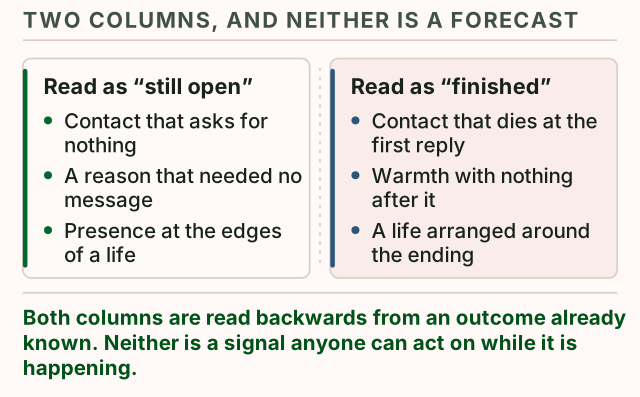
How do you know when a fearful avoidant is done?
The finished version deserves the same level of detail, because the kindest thing a page like this can do is describe it plainly.
Contact cuts rather than thins. Sparse becomes none, without drama and without a farewell. Deactivation keeps a thread — a check-in, a watched story, a tracked life. A finished ending lets the thread drop.
Questions about your life stop. Not just to you — to the mutual world. Nobody mentions being asked about you anymore, because nobody is being asked.
Logistics get closed cleanly. The belongings come back, the accounts get separated, the open items get resolved. The person is removing the reasons contact would happen, which is the opposite of keeping the door touched.
Your distance produces nothing. You go quiet, and no check-in arrives, no watching intensifies, nothing moves. This is the mirror of the sign above, and it is the most reliable of the cluster, precisely because it is the hardest to fake in either direction.
The reversals stop. The defining move of this pattern is the unexplained return — warmth after withdrawal, contact after silence. When a long, even stretch passes with no pulse at all, the pattern is no longer running on you.
Two honest complications. First, early on, a finished ending and a deep shutdown can look identical from outside — the same silence, the same flatness — and no outside test separates them in that stretch; only the shape over time does. Second, “done” in this pattern is often decided during a shutdown, which means the person may act finished, discover later that the state has passed and the attachment has not, and reappear carrying regret. That sequence — the abrupt discard and what sometimes follows it — has its own page.
What we send
The breakup, without the countdown
That did not go through. Nothing was saved and nothing was sent — try the address again, or write to us directly and we will add it by hand.
- It never tells you what you are, or what anybody else is.
- It carries no figures, because this guide publishes none.
- It arrives when a page changes, and stays quiet when none does.
One email on what a fearful-avoidant ending is and isn't. No spam, unsubscribe anytime.
No contact and a fearful avoidant
People arrive at “no contact with a fearful avoidant” looking for two things this page will not provide: a duration, and a promise about what the silence will produce. What it can provide instead is a description of how silence actually lands inside this pattern — which is worth having, because the standard no-contact advice was written for a different kind of ex.
Silence reaches a fearful avoidant in phases that are describable without being schedulable. The first phase tends to be relief: the pressure is gone, the alarm settles, and the early quiet reads from outside like indifference. Then, if the attachment underneath is alive, the muting loosens and the pull can return — this is when the watching starts, the small openers, the pulse. Or the second phase does not arrive: the quiet holds, becomes ordinary, and the thread closes. Both sequences are real. Nothing visible on day whatever tells you which one you are in, and the popular “no contact stages” content that claims otherwise is describing a script, not a person.
Two things follow from the mechanism. In practice, pursuit during the silence tends to restart the alarm — each message lands as more of the pressure that was fled, so breaking your own silence to “check in” tends to buy the opposite of what it hopes. But engineered silence is not a lever either. The reach-back, if it comes, comes because the alarm settled and the attachment surfaced — not because a technique was executed correctly. Stopping contact does not make a return happen; it makes a return possible, and possible was never yours to convert.
Which reframes the real question. If you step back, do it because living in a posture of constant reaching costs too much and because your own recovery needs the room — reasons that hold up whether or not anyone comes back. A silence run as a tactic has a clock on it, and when the clock runs out it collapses into pursuit. A silence run for your own sake does not need the other person to do anything for it to have been worth it.
How long does it take for a fearful avoidant to come back?
There is no honest interval to give, and the numbers that circulate were invented. Popular pages on this topic print one — a number of weeks for the relief to fade, a number of months for the return. This site does not, and the reason is worth stating plainly rather than buried: no measured interval for any of this exists to cite in the attachment literature. The figures that circulate are not findings; they are copied from page to page because a number is the most quotable thing a page can contain. Printing one here would be the site’s most shared sentence and its least true.
There is also a deeper problem than sourcing. A timeline promises that the event is on a timer, and it is not — it is responsive. What the gap before a reach-back appears to track is not elapsed time but state: whether the pressure actually stopped, whether the person has somewhere for the alarm to settle, whether the exit was an escape from the alarm or a decision about the relationship, and whether the same loop has run before, because each run teaches both people what the silence means. Two endings with identical calendars can be entirely different events.
So the honest version of “how long to go no contact with a fearful avoidant” is: the question has no unit. What has a unit is your side — how long waiting is compatible with your own life. That number exists, is different for everyone, and is the only one worth setting.
What this page doesn't offer
- No timeline
- No weeks, no months, no stages with day-counts attached. No measured interval for fearful-avoidant returns exists to cite, and the ones circulating online are inventions.
- No odds
- No percentages, no 'most come back eventually.' Whether a specific person returns is not knowable from a page, and dressing a guess as a statistic would be the dishonest version of hope.
- No win-back method
- Nothing here is a technique for producing a return — not silence run as a tactic, not engineered jealousy, not scripted messages. The mechanism is not operated from outside, and selling levers that don't exist is this category's stock in trade.
- No verdict on your ex
- This page describes a pattern. It cannot tell you whether your person is deactivated or done, and it will not guess.
A last word for the reader refreshing a chat that has gone quiet. This page has described why the door tends to stay ajar in this pattern, and that description can itself become a trap — an ajar door is a reason to keep watching it. The pattern permits returns; it does not owe you one, and a return, if it comes, arrives carrying the same cycle that ended things. What happened to you has a shape, the shape has a name, and neither requires you to keep the porch light on. How the ending itself unfolded is laid out stage by stage — and that page, like this one, comes without a calendar.