Search for fearful avoidant core wounds or fearful avoidant self-sabotage and the story behind the search tends to be the same one: a relationship that was finally working, ended or damaged by the person who wanted it. Plans cancelled at the last minute, feelings denied days after they were spoken, a sudden catalogue of the partner’s faults right after the best weekend of the year. This page describes that experience as what it is — a sequence with a recognisable shape — rather than what it gets called, which is brokenness.
Fearful avoidant core wounds are the pair of standing expectations underneath that sequence: get close and you will be rejected, and get close and you will be trapped. Carrying both at once is what makes the pattern alternate instead of settle.
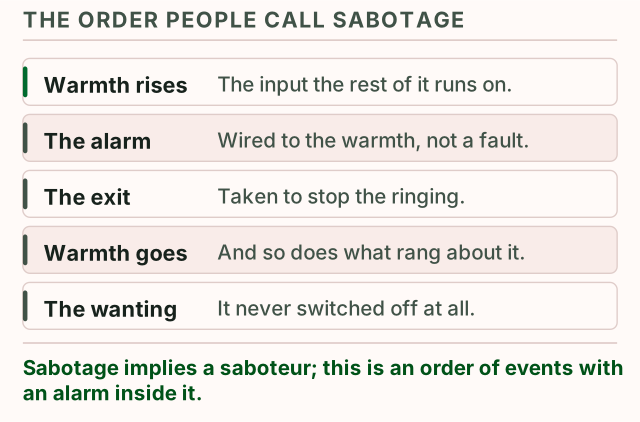
The word “sabotage” is doing a lot of unfair work in that search. Sabotage is a word that implies a saboteur: someone who wanted the bridge down. What people actually describe is closer to a fire alarm wired to warmth — the better things get, the louder it rings, and the exits get taken to stop the ringing. The rest of the healing section is about rewiring; this page is about seeing the wiring clearly first.
What does self-sabotage mean in this pattern?
Here, self-sabotage means acting against a relationship you value at the moment it is going well, in ways that relieve pressure now and cost you the thing later. It is not carelessness, and it is not secret indifference. The person cancelling the plan or picking the fight is often the same person who will spend that night regretting it.
The phrase “core wounds” is everywhere in this corner of the internet, so it deserves a plain definition. It is not a clinical term, it does not come from the attachment literature — where the fearful-avoidant pattern is described in terms of relating, as in the four-category model of adult attachment — and this page does not use it as one. As the niche uses it, the core wounds of a fearful avoidant are a pair of standing expectations: get close and you will be rejected; get close and you will be trapped. Other patterns are described as carrying one of these expectations. This one carries both at once, which is why neither distance nor closeness ever settles the system — each one triggers the other expectation. Self-sabotage is what that double bind looks like from outside.
That framing matters for what follows. If the behaviour came from not caring, more evidence of caring would stop it. It does not stop it — often the opposite — because the behaviour comes from the alarm, and the alarm is wired to closeness itself.
What does the sequence look like?
People who recognise this pattern in themselves describe the same arc, reliably enough that it can be written as a sequence.
It starts with good. Not conflict — closeness. For example: a weekend that went too well, a partner who said the right thing, a moment of being fully seen. Then, close behind it, something that does not feel like fear at first: restlessness, irritability, a sudden critical eye. The partner’s laugh is annoying now. The relationship feels like a room with the door painted shut.
Then comes distance, taken in whatever form is nearest — a cancelled plan, a picked fight, a stretch of one-word replies, or the full shutdown described on the deactivating page. The distance brings relief, and the relief feels like information: see, I’m calmer away from them — maybe this isn’t right.
Last comes the explanation, written after the fact. “I lost feelings.” “We’re too different.” “I’m not ready.” The reasons are assembled to fit the exit that was already taken, which is why they tend to sound thin even to the person saying them. The sequence read backwards looks like a considered decision. Read forwards, it is alarm, distance, relief, and a story to make the relief make sense.
What sets the sequence off is covered in its own right on the triggers page — the point here is the order. The doubt arrives after the distance, not before it. That single detail is what separates this pattern from ordinary falling out of love, and it is the detail worth checking against your own history.
What forms does it take?
The sequence wears different clothes on different people. The forms people describe:
Cancelled plans. Consider a plan made sincerely, from the warm state: as it approaches, it converts into an appointment with closeness and the alarm starts. Cancelling produces instant relief — which is exactly why it becomes a repeating move rather than a one-off.
Sudden criticism. The partner has not changed; the lens has. Fault-finding creates justified distance — you can step back from a flawed person without being the one who broke something. When the state passes, the faults shrink back to human size.
“I’ve lost feelings.” Sometimes true, and sometimes a state reporting itself as a fact. The protective shutdown mutes feeling for the partner; from inside, muted reads as gone. The tell people describe is timing — the feelings vanish right after closeness peaks, and sometimes reappear once distance is restored.
Denying what was said. Feelings spoken in the warm state get walked back in the alarmed one — not always as strategy, but because admitting attachment feels like handing someone the means to hurt you. Both statements were sincere when made. That is what makes it maddening from the receiving end.
Testing and provoking. Starting the fight, going quiet, watching what the partner does with it. The constant background scanning for signs of rejection — the thing the niche calls hypervigilance — eventually stops waiting for evidence and manufactures a test instead. A partner reading this from the other side may recognise the pattern from the receiving end; the honest version of that experience has its own pages.
Lashing out. When the trapped feeling and the rejected feeling fire together, the result can be an outburst wildly out of scale with its trigger — followed, characteristically, by shame and withdrawal, which restarts the distance phase with extra fuel.
Different costumes, same play: warmth, alarm, distance, story.
What do people describe noticing first?
Change in this area does not start with stopping the behaviour. It starts earlier and smaller: noticing the sequence while it is running instead of after the damage is done.
The first thing people report catching is the pivot — the moment goodness turns into irritation. Not preventing it; just seeing it. For example, that sounds like: We had a great night and now I want to criticise her. That’s the pattern. Naming it does not switch it off, but it opens a gap between the alarm and the act, and everything that can be called progress lives in that gap.
The second is catching the explanation phase — noticing that the reasons for leaving were written after the urge to leave, not before it. People describe this as the stranger discovery of the two: watching your own mind produce a plausible story on demand, and realising past stories may have been produced the same way.
What people say helps at this stage is not willpower but delay: a private rule that no plan is cancelled and no relationship-ending sentence is said while the alarmed state is running. Not because the state is wrong, but because it is temporary, and decisions outlast it. What the longer arc of that work looks like is the subject of the becoming secure page.
What this page doesn't offer
- No diagnosis by list
- Recognising yourself in a sequence on a website is a starting point for curiosity, not a verdict. An attachment pattern is a description, and this page cannot see any actual person.
- No 'core wound healing' promises
- Pages that promise to heal your core wounds in a set program are selling certainty no one has. This site describes the pattern; changing it is slow, personal work, done best with a professional.
- No blame assignment
- Neither the person running this sequence nor the partner absorbing it is cast as the problem here. A pattern description is not a character reading of either side.
- No exercises
- This page deliberately stops at description. Practices and protocols are not offered here, because the useful version of them is chosen with someone who knows your history.
What we send
The sequence, named in one letter
That did not go through. Nothing was saved and nothing was sent — try the address again, or write to us directly and we will add it by hand.
- It never tells you what you are, or what anybody else is.
- It carries no figures, because this guide publishes none.
- It arrives when a page changes, and stays quiet when none does.
One email walking through the reach-out, push-away loop. No spam, unsubscribe anytime.
Where this page stops
This page describes a behavioural sequence as people recognise and report it. It does not explain where the pattern comes from, it does not diagnose anyone, and reading it is not the same as being seen by someone who can. If the sequence described here is costing you relationships you want to keep, or if what drives it feels heavier than a pattern — closer to something with a history that deserves attention in its own right — the useful next step is not another article but a conversation with a therapist, who can look at your particular wiring in a way a page written for everyone cannot.