
People who search for how to go from fearful avoidant to secure tend to be asking after a recognition, not before it: the cycle has been seen — the reach toward someone, the retreat from the same someone — and the question has moved from “what is this” to “does it have to stay this way.” This page describes what movement toward secure attachment looks like in the fearful-avoidant pattern, in the order people tend to notice it, and what a relationship with a steady partner does and does not contribute. What it will not do is hand over a staged program with a timeline, because none exists to hand over. The wider question of what “healing” even means for this pattern is the healing overview’s job; this page is about the destination end of it.
Going from fearful avoidant to secure is not a border crossing but a change of ratio: the alarm still fires, and it stops being the thing that decides what happens next.
What does “earned secure” describe?
“Earned secure” is a label from the attachment research literature, the adult strand of which Mikulincer and Shaver survey in an open-access review. It describes adults whose current way of relating reads as secure even though their history would not have predicted it. The term is worth pausing on, because both halves of it correct a common misreading. “Earned” says the security was built rather than issued — it is the same word researchers use whether the change came through a relationship, through therapy, or through years of ordinary practice. “Secure” is a description of the present pattern of relating, not a personality transplant.
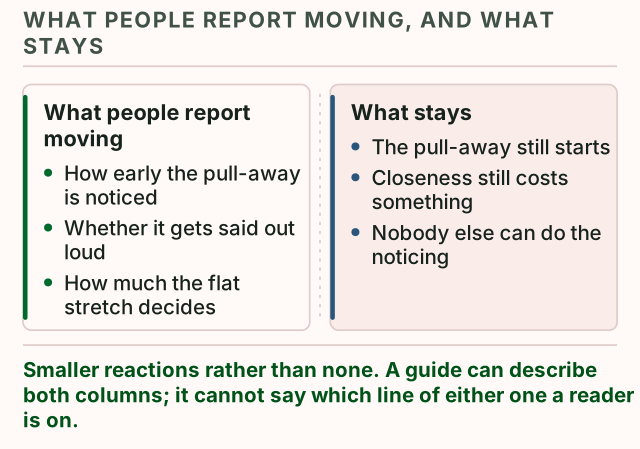
What the label does not describe is the absence of the old pattern. People whose relating has shifted this way still report the familiar flare. Consider the impulse to pull back after a close weekend, or the flash of suspicion at kindness. The difference is what happens next: the flare is recognised as the pattern rather than as information about the partner, and it stops being the thing that decides what happens. Secure, in this reading, is not a state where the alarm never sounds. It is a state where the alarm no longer runs the building.
That reframing matters because the search phrase — from fearful avoidant to secure — pictures a border crossing, and the change people actually describe is more like a shifting ratio. The pattern loses its votes long before it loses its voice.
What changes, and in what order do people notice it?
Not in stages — despite what the phrase “fearful avoidant healing stages” implies, no measured sequence exists, and the numbered lists that circulate are inventions. What can be described is an order of noticing that people report, which is a different and humbler thing.
The story gets accurate after the fact. The earliest change tends to be retrospective. For example, a shutdown ends, and instead of the standard explanation — lost feelings, wrong person — the person can see what actually happened. “Things got close, and I went cold.” Nothing about the behaviour has changed yet. The account of it has, and everything else builds on that.
The pull-away gets noticed while it is happening. Later, the recognition arrives in real time: the urge to cancel, the sudden case against the partner, the flatness — felt as the pattern switching on rather than as the truth revealing itself. What that switch-on looks and feels like is described in full on the deactivating page; the change here is only that it is now visible from inside while it runs.
The retreat gets named instead of enacted. The next thing people describe is saying it out loud: telling the partner that the distance is rising, that it is about closeness and not about them, and that it passes. The pull-away still happens. What disappears is the vanishing — the partner is no longer left alone with an unexplained silence to interpret.
Repair comes sooner. Shutdowns and flare-ups still occur, but the gap between the rupture and the return shrinks, and the return starts carrying words with it. This is the change partners tend to notice first, often before the person notices anything at all.
Good moments stop needing to be paid for. Latest, and reported quietly: warmth arrives without the automatic bracing afterwards. The pattern where things break precisely because they are going well — taken apart on the self-sabotage page — fires less often, and less hard, and recovers faster when it does.
None of this is offered with durations, because attaching months to it would be invention. The order itself is also a tendency people describe, not a track with checkpoints; some notice the later items first.
What does a secure partner do — and not do?
The search phrases pairing “fearful avoidant” with “secure attachment relationship” tend to be asking one of these questions: can this pairing work, or will the steady partner’s steadiness transfer. The honest answers are “yes, describably” and “not by itself.”
What a steady partner changes is the input. For example, a person whose warmth does not flicker, who says what they mean, and who does not punish the retreat gives the fearful-avoidant alarm less material: fewer mixed signals to scan, less ambiguity to fill with worst cases, no pursuit to confirm that closeness is a trap. People in the pattern describe this as the alarm firing less often and settling faster — the cycle still runs, but shallower.
What a steady partner cannot do is the noticing, the naming, or the staying. Those happen inside the person with the pattern or they do not happen, and a partner who takes them on as a project tends to burn out in a specific, recognisable way. The view from that side of the relationship — what it costs and what is reasonable to expect — has its own page. A secure partner is weather, not treatment: better weather genuinely helps, and nobody’s roof gets fixed by a good summer.
It cuts the other way too. A partnership is not a requirement for the change. The reading of “earned secure” that says find a secure person and absorb it quietly outsources the work to someone who cannot do it — and makes the change hostage to staying chosen.
Why aren’t “success stories” evidence?
People search for fearful avoidant success stories for an understandable reason: they want to know the change is possible before investing in it. The wish is legitimate. The genre that answers it is not, and this site does not publish it — here is the reasoning, since an unexplained refusal would just look like a gap.
An anonymous account of transformation cannot be checked: not the starting pattern, not the change, not whether the author exists. The stories that circulate are also selected — the attempts that went nowhere do not get written up, so the visible set is all endings that worked, which says nothing about what any given attempt should expect. And the genre has a commercial engine: transformation stories are the standard sales instrument for courses and “detox” programs, where the story exists so that the checkout button makes sense. A page that invented a composite recovery for you to identify with would be doing the same thing at one remove.
The honest version of reassurance is smaller and holds up better: the change described above is the kind researchers went looking for when they coined “earned secure,” and the mechanics of it — noticing, naming, staying — are describable without a single testimonial. Possible is not the same as guaranteed, and this page will not pretend to know which one a reader gets.
What we send
Toward secure, one letter at a time
That did not go through. Nothing was saved and nothing was sent — try the address again, or write to us directly and we will add it by hand.
- It never tells you what you are, or what anybody else is.
- It carries no figures, because this guide publishes none.
- It arrives when a page changes, and stays quiet when none does.
One email walking through the reach-out, push-away loop. No spam, unsubscribe anytime.
What this page doesn't offer
- No stages, no timeline
- No measured sequence from fearful-avoidant to secure exists to cite. Any page printing numbered stages with durations has invented them, and following an invented map tends to produce worry about being behind on it.
- No program
- Nothing here is a protocol, a detox, or a set of exercises. This site describes what change looks like; the structured work of producing it belongs with a professional who can see the whole person.
- No promised outcome
- Movement toward secure is describable and the direction is real. Whether a particular person gets there, how far, and by when is not something any page can know — so this one does not claim to.
- No testimonials
- No composite characters, no reader stories retold as proof. An account that cannot be verified is not evidence, and this site does not manufacture the feeling of evidence.
Where this page stops
This page describes what movement toward a more secure pattern looks like from the outside and the inside; it cannot see any particular reader, and it cannot tell an attachment pattern apart from a clinical condition that deserves attention in its own right. An attachment style is a description, not a diagnosis, and “earned secure” is a research label, not a status this site can assess or award. If the work described here keeps stalling in the same place, or the reactions involved feel larger than a relationship habit, the useful next step is a conversation with a therapist or a doctor, who can look at the whole person where this page can only see a pattern.