Searches for how to love someone with disorganized attachment tend to come from someone who is already doing it — and finding that the usual instincts backfire. Reassurance gets deflected, closeness triggers distance, and the harder they try, the further the other person seems to move. This page is written for that reader: what partners can actually do, what is not theirs to do, and where the honest limit of a written page sits.
Loving someone with disorganized attachment is largely a matter of what you stop doing. The pattern treats closeness itself as the hazard, which means the closest person is structurally unable to be the one who switches the alarm off — and most of the usual loving responses feed the cycle instead.
It belongs to the wider picture of the pattern inside relationships, and it holds to this site’s rules throughout: it describes, it does not prescribe, and it will not tell anyone to stay or to go.
What do partners ask most?
The questions that lead people here have a shape. How do I make them feel safe. How do I talk to them when they’ve gone quiet. How do I help them heal. How do I deal with this. Underneath them runs the same assumption: that there is a correct input which, applied skilfully enough, produces a steady partner.
The assumption deserves a direct answer, because everything else on this page depends on it. There is no such input. The pattern is a protective system that reads closeness itself as the hazard, which means the partner — the closest person — is structurally unable to be the one who switches it off. Warmth is not neutral to this system; warmth is what trips it. That is why the most loving efforts often precede the deepest retreats, a timing described in detail on the deactivating page.
What partners can do is real but smaller than the search implies: they can stop feeding the cycle, and they can remain recognisably themselves while it runs. The rest of this page unpacks both — and then draws the line where a partner’s part ends.
A further reframe before the practical sections. Partners often interpret the retreats as evidence about themselves: not attractive enough, too much, not enough. The pattern’s actual trigger is closeness, not the partner’s inadequacy. Withdrawal after a good weekend is not a review of the weekend. Letting go of the verdict-reading is the change partners describe again and again as making the relationship survivable — not because it changes the other person, but because it stops the reactive counter-cycle from starting.
What does predictability actually mean here?
It means being the one behaviour their alarm cannot convert into evidence. “Be predictable” sounds thin next to what partners are living through, so it is worth being precise about what it means and why it matters to this pattern specifically.
The fearful-avoidant system runs on a paired expectation: that closeness will hurt, and that people will confirm it. Every dramatic response a partner produces — the pursuit, the wounded withdrawal, the retaliatory silence — lands as confirmation. Predictability is the behaviour the system cannot easily convert into evidence. It is not a technique aimed at the other person; it is the refusal to become a character in the story their alarm is telling.
In practice it looks unglamorous. Saying what you mean without encoding it. Doing the small things you said you would do, at the time you said. Reacting to the retreat the same way each time — acknowledged, not punished, not chased. Being the same person on the warm days and the cold ones. None of this reads as romance, and none of it produces quick results, which is why it is underused: the behaviours that feel most responsive in the moment tend to be the ones that feed the cycle.
Predictability has a boundary worth naming, because partners overshoot it. It does not mean having no reactions, suppressing hurt, or absorbing any behaviour without comment. A partner who goes silent about their own experience to keep the peace has not become steady; they have become opaque, and opacity reads as danger to this pattern too. Steadiness includes saying plainly when something hurt — plainly, without repetition, and without staging it as a test.
How do you talk to someone during a shutdown, and after it?
Communication advice tends to fail here because it ignores timing. There are distinct windows — during a shutdown and after it — and what works in one reliably fails in the other.
During a shutdown, the honest news is that talking tends not to work, and this is nobody’s failure. A shutdown is not a position being held that better arguments could release; the person’s capacity for connection is offline, and language aimed at reopening it tends to land as pressure. For example, partners describe the experience of reasoning with a wall, and the description is apt — not because the person stopped caring, but because the channel itself is what closed. What partners report as least damaging in that window: naming their own availability briefly, without a question mark attached, and then genuinely withdrawing the pressure. “I’m here when you’re ready” is a complete message. Its repetition is not.
After the shutdown is where the actual conversation lives. The pull toward connection tends to return once distance has lowered the alarm, and the person often reappears warm, as if the gap had not happened. Partners face a real choice at that moment: raise the gap or let it pass. This page does not make that choice for anyone, but it can describe the trade. Raised immediately and with heat, the gap-conversation tends to re-trigger the retreat it is about. Never raised at all, the gaps become the relationship’s unspoken architecture. What people in long relationships with this pattern describe as workable is naming the cycle at a calm moment, as a shared observation rather than a charge — talking about the pattern rather than prosecuting the instance.
A caution belongs here. Announcing a partner’s attachment style to them, uninvited, is not the same as naming a cycle you are both inside. This site’s consistent position is that patterns are descriptions people apply to themselves; delivered across a kitchen table as a finding, the label tends to arrive as a verdict, and verdicts are what this system is armed against. The related question of whether a partner’s difficult behaviour is a test, and what that framing gets wrong, is taken up on the testing-or-love page.
What is not yours to fix?
A whole genre of advice treats a partner’s pattern as a repair job waiting for the right mechanic. That framing is banned on this site, and this section is why. The premise fails at both ends: a person is not broken for having a protective pattern, and a partner is not positioned to be the repair even if they were.
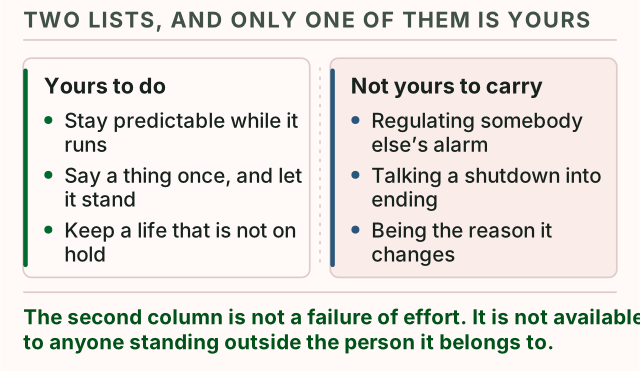
The division is worth stating in plain columns, because partner exhaustion tends to come from working the wrong side of it.
Yours: your own behaviour and its consistency. Your words matching your actions. Your honesty about what hurts and what you can carry. Your limits, stated rather than performed. Your side of any cycle the two of you run — because pursuit, punishment, and counter-testing are contributions, and they are the only contributions you control.
Not yours: the other person’s nervous system. The timing of their retreats and returns. Whether they recognise the pattern, whether they name it, and whether they decide to work on it. Their history and what it means — that account belongs to them and, if they want company in it, to a professional. The outcome.
The “not yours” column is not a counsel of coldness. It is the observation, consistent across what people in these relationships describe, that a partner who takes over the “not yours” column loses their own. Monitoring moods, pre-empting triggers, managing the person’s inner weather — this is full-time work, it is invisible, and it converts a partner into a caretaker. The pattern, meanwhile, does not improve from being managed. If it shifts, it shifts through the person’s own recognition and, often, through professional work — what that change actually looks like is described on its own pages, and none of it lists the partner as the mechanism.
Looking after yourself in this
A page addressed to partners owes them this section, because the searches that lead here are not only about the other person. Living opposite this pattern has a recognisable emotional shape: warmth and distance arriving from the same source, on a schedule that follows their alarm rather than anything you did.
The costs partners describe are consistent. Consider vigilance — scanning for the next retreat even in good stretches. Shrinking — trimming their own needs, questions, and reactions to avoid setting anything off. Isolation — the pattern’s private logic is hard to explain to friends, and the visible story (“they’re distant sometimes”) undersells the lived one. Self-doubt — the verdict-reading described above, turned chronic.
None of these costs is an argument for leaving, and their absence would not be an argument for staying; this site does not issue those verdicts. But the costs are information, and partners tend to discount them precisely because the other person’s pattern has an explanation. An explained hurt is still a hurt. A partner’s needs do not become negotiable because the person who cannot meet them has a reason.
What partners describe as protective is ordinary and easily postponed: keeping their own friendships and routines running through the cold stretches rather than suspending life until the warmth returns; saying what they need in plain language even when the answer may be no; and letting people outside the relationship see them accurately. A partner with a life that continues during the retreats is also, incidentally, the steadier figure this page has been describing — but that is a side effect, not the reason. The reason is that their life is theirs.
Where this page stops
This site describes a relational pattern as it appears in adult behaviour. It does not diagnose anyone, treat anything, or stand in for professional care, and its editors have no clinical qualifications and do not imitate them. This page in particular sits close to the line, because “how do I help my partner” is often a short step from “how does my partner change” — and that second question, asked seriously, is therapeutic territory. Work on attachment patterns, individually or as a couple, belongs with a licensed mental-health professional, who can respond to the actual people involved rather than to a general model. Nothing here is a substitute for that, and nothing here should be carried into a relationship as a program.
What this page doesn't do
- No repair project
- This page will not help you change your partner, and it holds that the attempt itself is part of what exhausts these relationships. A pattern shifts through the person's own work, not through a partner's management of it.
- No verdict on staying or leaving
- Whether this relationship is right for you is a question about your life. A description of a pattern cannot answer it, and a page that pretended to would be overstepping what description can do.
- No ultimatum templates
- No deadlines, conditions, or consequence scripts. Ultimatums convert a shutdown into a test the shut-down person is guaranteed to fail, and people inside the pattern describe them as a ready-made exit.
- No couples exercises
- No dialogue drills, no structured check-ins, no homework. Exercises for two people working on attachment belong in a therapy room, where someone qualified can see what a page cannot.
What we send
The partner's side, in a letter
That did not go through. Nothing was saved and nothing was sent — try the address again, or write to us directly and we will add it by hand.
- It never tells you what you are, or what anybody else is.
- It carries no figures, because this guide publishes none.
- It arrives when a page changes, and stays quiet when none does.
A plain-language walkthrough of the reach-then-withdraw cycle from the receiving end. No tactics, no promises of outcomes. Unsubscribe anytime.