Searches about dating fearful avoidant attachment come from a specific moment: the early weeks were unusually good, and now something has changed that no argument explains. The replies got shorter, the plans got vaguer, and the person who set the pace has gone quiet. This page describes that sequence — what it tends to look like, why it follows closeness rather than conflict, and how it reads from both sides of the table.
Dating a fearful avoidant is dating a pattern with two speeds: an unusually fast, attentive start, and a stall that arrives once the relationship stops being hypothetical — after the good weekend rather than after a misstep.
It sits inside the wider picture of the pattern in relationships, and it stays descriptive throughout: no message scripts, no strategy, no ruling on whether anyone should stay.
What does early dating look like?
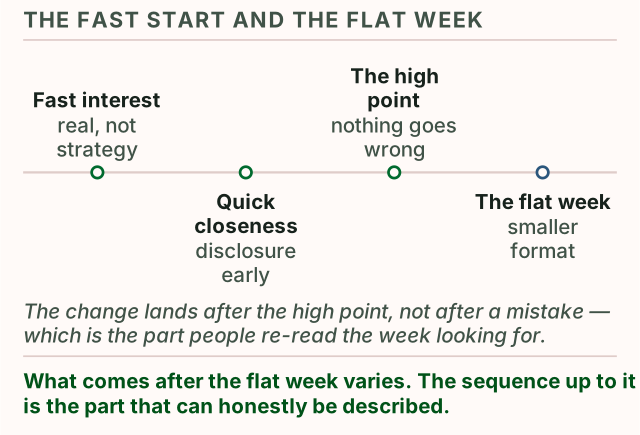
The early phase often looks like the opposite of avoidance. People dating someone with this pattern describe fast, attentive interest. For example: long conversations, quick disclosure, the feeling of being chosen decisively. The approach half of the pattern runs freely at the start because distance is still built in — nothing has been promised, nothing can yet be lost.
The recognisable shift comes when the relationship stops being hypothetical. A weekend that went well, a conversation that touched the future, meeting friends — the moments a new couple would file as progress are the moments the protective half of the system switches on. What follows is a cooler stretch: contact drops, enthusiasm flattens, plans slip. The mechanics of that shutdown are described on the deactivating page; in dating, its signature is timing. The distance lands after the high point, not after a misstep.
None of this is unique to a single date or a single person. What people report recognising, in a partner or in themselves, is the repetition: the same fast start and the same stall, across different relationships, with the trigger being closeness itself.
What follows the fast start?
A stall, and one the partner can find no cause for. The fast start is the half people misread most. From outside it can look like exceptional certainty — and when the retreat comes, the same partner rereads it as performance. Neither reading fits the pattern. The early intensity is real; it is simply running without the alarm that closeness will later set off.
That is why the stall is so disorienting. The partner did nothing wrong and can find nothing to repair. They go looking for a cause — something said, something asked too soon — and the search fails, because the cause was the closeness, not a mistake inside it. The behaviours that then appear, the sudden distance and the odd questions, are the same ones partners later describe as tests; how that label holds up is examined on the testing-or-love page.
The arc does not end at the stall. If the relationship survives it, the pull toward connection tends to return once the distance has lowered the alarm, and the couple discovers this was not a phase but a shape. Long relationships and marriages with this pattern get described the same way: not the absence of the cycle, but both people learning what it is.
Why do the texts get shorter and the gaps longer?
Texting is where the cycle shows up first, because texting is where closeness is measured in the early weeks. The general shape: message frequency tracks the cycle, not the relationship. During the approach phase the thread is alive at all hours; during a retreat it goes thin — shorter replies, longer gaps, warmth replaced by logistics. The scenarios below are the ones the searches that lead here keep describing.
Not texting back
The silence tends to arrive after contact has peaked, and without an announcement. From inside the pattern, an unanswered message is not a message being composed to hurt; it sits unanswered because answering means re-entering the closeness that set off the alarm. People describe opening the thread, feeling the pressure of it, and closing it again. From outside, the same days read as indifference. Both descriptions are of one event.
Replying, but colder
Sometimes the replies keep coming and only the temperature changes: single lines where there were paragraphs, practical answers to warm questions, no questions coming back. The cold reply is often the compromise position — enough contact to keep the connection alive, enough flatness to keep it at arm’s length. Partners tend to experience this as worse than silence, because it invites them to guess.
The late-night message
The reversal often comes at night, and often warmly, as if the gap had not happened. This is the moment partners find hardest to read — an affectionate message after days of distance looks contradictory. In the pattern’s terms it is consistent: distance lowered the alarm, and the pull toward the person came back the moment it was quiet enough to be felt. The message is not an apology and rarely comes with an explanation, because from inside, the retreat did not feel like a decision that needs one.
A note on what this section is not: it describes the pattern’s texting so that the receiving side can stop inventing worse explanations. It is not a decoding manual, and it does not say what to reply, because a reply chosen as a technique becomes a move in exactly the game neither person wants to be in.
What is dating like as a fearful avoidant?
From the inside, early dating is the most exposed position the pattern knows. A crush is already a conflict: wanting to be seen by exactly the person it feels dangerous to be seen by. People who recognise themselves in this describe the early weeks as split-screen — genuinely falling for someone while a parallel commentary looks for the exit.
The behaviours that follow are the ones this page has been describing from the other side. In practice: cancelling the plan that felt exciting when it was made. Drafting replies and not sending them. Feeling relief when a date is postponed, then missing the person the same evening. Ending things abruptly when it gets good, and grieving the ending as if someone else had chosen it. Recognising this in oneself is not a verdict; the same recognition is where change in the pattern tends to start.
Other situations from the search bar belong here as well. When both people carry the pattern, the starts are faster and the collisions harder — each person’s retreat confirms the other’s alarm, and repair depends on someone naming the cycle out loud. When the other person leans dismissive-avoidant instead, the retreats can look alike from outside while running on different logic — that distinction is drawn out on the fearful vs dismissive comparison. And how the pattern is read often differs by gender: the same retreat gets called different names in men and in women, which is taken up on the men-and-women page.
What doesn’t help?
This section stays descriptive too: not advice on what to do, but a record of what people on both sides consistently report making the cycle worse.
Pressure for definition during a retreat. The demand to label the relationship lands, from inside the pattern, as closeness arriving at gunpoint — the exact condition the retreat was protecting against. The answer it tends to produce is the exit.
Consider ultimatums. “Reply by tonight or we’re done” hands the shut-down person an exam they cannot sit. People inside the pattern describe ultimatums as almost restful — a reason to leave that requires no explanation.
Tests in return. Matching the silence, delaying replies to reclaim standing, going cold strategically. It is understandable, and it feeds the pattern its favourite evidence: that warmth was conditional all along. When each person is testing the other, both are getting answers, and none of the answers are true.
Diagnosing across the table. Naming a date’s attachment style to them, uninvited, tends to arrive as a verdict rather than an insight — and this site’s position is that patterns are descriptions people apply to themselves, not labels applied to others.
What this page doesn't do
- No message scripts
- No templates for what to send, when to send it, or how long to wait. A scripted message is a tactic, and tactics feed the exact mistrust this pattern runs on.
- No verdict on staying or leaving
- Whether to keep dating someone is a question about your life, not about their pattern. A description of a cycle cannot answer it and should not pretend to.
- No timelines
- No answer to how long the quiet stretch lasts or when the warm message comes. Numbers here would be invented, and invented numbers get treated as promises.
- No labels for the other person
- This page helps you recognise a pattern, not certify that a specific person has it. That certainty is not available from the receiving end of a text thread.
What we send
The early weeks, decoded in one letter
That did not go through. Nothing was saved and nothing was sent — try the address again, or write to us directly and we will add it by hand.
- It never tells you what you are, or what anybody else is.
- It carries no figures, because this guide publishes none.
- It arrives when a page changes, and stays quiet when none does.
No schedule, no sequence, no course. One link in every letter takes you off the list for good.