People type “signs a fearful avoidant is testing you” after a specific kind of week: things were close, then something shifted — a silence, a pulled-back plan, a question that felt like a trap — and now the relationship seems to hinge on giving the right answer to a question that was never asked out loud. This page takes that experience seriously and then complicates it, because the behaviours read as tests and the behaviours read as love are, in this pattern, the same behaviours seen from two sides.
Signs a fearful avoidant is testing you are the behaviours a partner reads as an exam — a silence that seems designed to see who breaks it, warmth withdrawn after a good weekend, a doubt voiced as bait. In this pattern they are more often an alarm going off than a procedure being run.
The pattern in question is the fearful-avoidant one: wanting closeness and defending against it at the same time. How that plays out across a whole relationship is the territory of the in-relationships hub; this page stays on one question — when the behaviour looks like a test, what is actually happening, and what the signs of genuine attachment look like through the noise.
What do people mean by “a fearful avoidant is testing you”?
The label gets applied to a familiar set of moves. For example: a stretch of silence that seems designed to see who breaks it. Warmth withdrawn right after a good weekend, as if to check whether the withdrawal gets noticed. A doubt voiced at a strange moment — “you’d probably be happier with someone easier” — that reads as bait. Plans made and then loosened, attention given and then rationed. From the receiving end, each of these feels like an exam with hidden marking criteria.
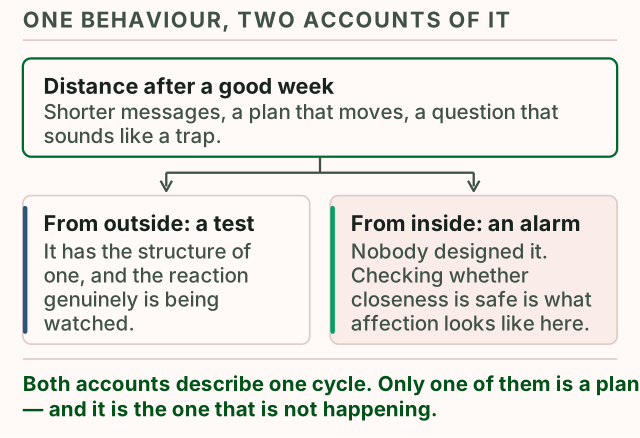
“Testing” is a natural word for it, because the behaviour has the structure of a question: something is done, and the reaction is watched. Where the label overreaches is in the intent it assumes. A test is a designed procedure with a desired result — a person who knows what they are checking for and is checking for it deliberately. Some of that exists; people with this pattern sometimes describe, in retrospect, engineering a distance to see if it would be protested. But much of the behaviour is not designed at all. It is the pattern’s ordinary weather being read, from outside, as strategy.
That distinction matters for the reader, not just for fairness. If the behaviour is a deliberate exam, the natural response is to find the right answer. If the behaviour is an alarm going off, there is no right answer to find — there is a mechanism to understand. What this page describes belongs to the second category, and the difference changes what the receiving partner is actually dealing with.
What does the behaviour look like from inside the pattern?
Inside the fearful-avoidant pattern — the corner named in the four-category model of adult attachment, as the attachment literature describes it — closeness and threat are wired together. Warmth is wanted, and the arrival of warmth switches on a second system that treats the same warmth as exposure. What that collision produces, behaviourally, is the exact list partners read as testing — which is why the two readings track each other so closely.
| What it looks like from outside | What it often means inside |
|---|---|
| A test: silence to see who reaches out first | The alarm after closeness: contact feels exposing, and silence is the nearest exit |
| A test: pulling away right after the best week | The best week is the trigger; retreat follows good closeness, not conflict |
| Bait: 'you'd be better off without me' | A real fear said out loud, checking whether it gets confirmed or contradicted |
| Rationed affection, given then withdrawn | Approach and defence alternating faster than either can be explained |
| Watching your reaction to a cancelled plan | Checking whether the connection survives disappointment — safety-seeking, not scoring |
| Hot-and-cold as a game | Two genuine states taking turns: wanting you near, and needing the alarm to stop |
Two honest caveats belong here. First, this table explains behaviour; it does not excuse the cost of receiving it, which is real regardless of what is happening inside. Second, nothing on the outside can verify intent in a specific case. Consider two identical silences: one from a partner who is losing interest, one from a partner whose alarm has fired. What distinguishes them is not the single event but the surrounding pattern — whether the retreat reliably follows closeness, and whether the person reliably returns. What switches the retreat on is mapped on the triggers page, and what the shutdown itself looks like while it runs is described under deactivating.
What are the signs a fearful avoidant loves you?
Searches for “signs a fearful avoidant loves you” and “signs a fearful avoidant loves you but is scared” are the same question as the testing search, asked hopefully instead of suspiciously. The honest preface: none of these signs is proof, and love in this pattern rarely announces itself in the standard vocabulary. What people who know the pattern describe is love showing up in the following shapes.
- They come back. After every retreat, the movement resumes in your direction — the return, repeated over time, is the clearest signal the attachment is alive.
- The retreat follows your best moments, not your worst. Distance that arrives after depth is the pattern’s signature; distance that arrives after boredom is a different signal.
- Vulnerability leaks through in small, controlled doses. A hard story told once and never referred to again is a large event inside this pattern.
- They show care sideways. Practical help, remembered details, quiet acts — expressions that carry attachment without requiring an exposed declaration.
- Your absence visibly registers. They may not say they missed you, but the reach-out after distance says it behaviourally.
- They let you see the contradiction. Saying “I want this and I keep flinching” — in any words — is trust of a high order here.
- Plans slowly become real. Commitment tends to arrive in increments, and each increment that survives the alarm is a choice made toward you.
The corresponding negative deserves one plain sentence: a person who retreats and does not return, whose distance deepens regardless of closeness, may simply be leaving — the pattern explains contradiction, and steady, unreturning withdrawal is not contradictory.
Why do affection and distance arrive in the same week?
Because they are consecutive phases of one loop, not two competing messages about how someone feels. The disorienting part for partners is the proximity of the two halves: the open, warm, fully-present version of the person and the distant, unreachable version showing up days apart, with nothing visible in between to explain the switch. Read as strategy, this looks like manipulation. Read as mechanism, it is the pattern’s core loop running once.
The loop, compressed: closeness is wanted and pursued; closeness arrives; the arrival raises the internal alarm; distance lowers the alarm; the lowered alarm lets the wanting be felt again; the person moves closer. Affection and distance are not competing messages about how they feel — they are consecutive phases of one process, and a good week accelerates it, because a good week is precisely what raises the stakes. This is why the withdrawal lands right after the weekend that felt like a breakthrough, and why it arrives without an explanation the person themselves could give.
The full mechanism, including what the shutdown phase feels like from inside and how long the phases tend to run relative to each other, is the subject of the deactivating page — it is the engine behind everything this page describes.
What hurts a fearful avoidant most, and what doesn’t help?
“What hurts a fearful avoidant the most” is a real search, and it deserves a real answer rather than a leverage list. What people with the pattern describe as most painful: having the retreat treated as proof they never cared; being told they are playing games when they cannot themselves explain the distance; a vulnerable disclosure used later as an argument; being pursued hardest at the exact moment the alarm is loudest; and the partner disappearing precisely when the return movement had begun. Each of these confirms the pattern’s underlying fear — that closeness is unsafe and that being fully seen ends badly.
What doesn’t help is the mirror image, and it is worth being direct about because it is the most tempting move available: counter-testing. In practice: staging your own silence to even the score, withholding warmth to see if it gets missed, answering their question-shaped behaviour with question-shaped behaviour of your own. Two alarm systems interrogating each other produce noise, not information. The same goes for demanding a verdict mid-retreat (“tell me right now if you love me”) — the moment of highest alarm is the moment least capable of producing a true answer.
This page deliberately stops short of partner strategy. There are no scripts here for passing a test, because treating the relationship as an exam is the frame that keeps both people stuck. What a partner can realistically do day to day — and where the limits of that are — is its own subject, covered on loving someone with this pattern.
What this page doesn't do
- No tactics for passing tests
- If the behaviour is an alarm rather than an exam, there is no answer key, and supplying one would teach performance instead of understanding.
- No mind-reading verdicts
- This page cannot tell any reader whether their partner loves them or is leaving. It describes a pattern; the specific case belongs to the people in it.
- No character judgements
- We describe behaviour without ruling on what it makes someone. Labels end conversations that the behaviour itself should start.
- No advice to stay or go
- Whether the cost of the pattern is bearable in a given relationship is not a question a website can answer for you.
Everything after this point — how it started, what to do about an ended relationship — is out of scope here. What ends the confusion, in the experience this site draws on, is not decoding any single silence but seeing the loop whole: what switches it on, what the shutdown is, and what the return means. Start with the engine, then come back to the question of what any one week meant.
What we send
Testing or love, one letter on the difference
That did not go through. Nothing was saved and nothing was sent — try the address again, or write to us directly and we will add it by hand.
- It never tells you what you are, or what anybody else is.
- It carries no figures, because this guide publishes none.
- It arrives when a page changes, and stays quiet when none does.
No schedule, no sequence, no course. One link in every letter takes you off the list for good.