Search for quiet disorganized attachment and you will find pages that treat it as an established subtype, sometimes with a matching test. It is not one.
Quiet disorganized attachment is a reader’s phrase for the version of the fearful-avoidant pattern in which the retreat happens without a scene — no argument, no announcement, just less warmth each week. “Quiet” and “loud” are words readers coined because the same pattern — reach for closeness, then retreat from it — can be nearly invisible in one person and unmissable in another. This page describes what each word is pointing at, and why the difference is volume, not kind.
Where does “quiet disorganized attachment” come from?
It comes from readers, not from research. The attachment literature describes the fearful-avoidant, or disorganized, pattern as a single thing: closeness is wanted and closeness is threatening, so approach and withdrawal take turns. The researchers who named it — Main and Solomon, in the volume where the disorganized category was set out — did not split it into quiet and loud editions. Those words come from forums, comment sections and search bars — from people comparing notes and noticing that the pattern they were describing did not look the same in every account.
That origin matters for how the words should be used. A category from the literature carries a definition someone is accountable for. A search-born label carries a resemblance: “the version where nothing is ever said out loud” or “the version where every retreat is a storm.” The resemblance is real and worth describing, which is why this page exists. But nothing follows from the label itself — no test can sort you into one, and no page can tell you what a “quiet type” will do next, because there is no quiet type. There is a pattern, and there are louder and quieter ways it surfaces.
The same caution applies to the phrase highly disorganized attachment style. People who search it mean the pattern runs strongly — the cycle keeps returning, or it colours the whole relationship. That is a fair thing to want words for. But “highly” is not a measurement anyone has taken, and treating it as a grade of severity turns a description into something that sounds like an assessment. This site does not rank the pattern, in either direction.
What does the quiet version look like?
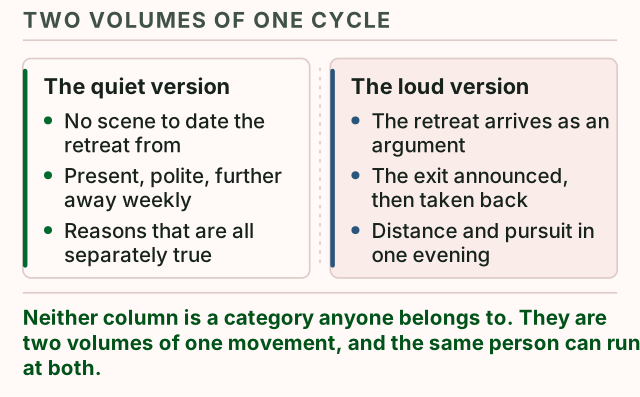
In the quiet version, the retreat happens without a scene. There is no argument to date it from and often no announcement. What partners describe instead is a change of temperature. For example: messages still arrive but carry less in them, plans stay technically alive but stop being proposed, affection becomes something received rather than offered. The person is present, polite, often perfectly pleasant — and somehow further away each week.
The quiet part is the explanation, or the absence of one. Asked directly, the person may say work is busy, or that nothing is wrong, and may believe both. The turn away from closeness in this pattern often happens below the level of decision — the mechanics of that shutdown are described in the deactivating page — so there is genuinely nothing to report from the inside. From the outside, that reads as withholding. From the inside, it can feel like weather.
This is the version that collects the labels fearful avoidant leaning dismissive and high functioning fearful avoidant. Both phrases notice the same thing: the visible half of the cycle is the withdrawal, while the reaching half — the part that distinguishes this pattern from plain distance — happens in private, or in ways easy to miss. Consider a person who holds a demanding job, keeps friendships in good order and answers every message within a day, and is still running the full approach–retreat loop inside their closest relationship. Smooth functioning elsewhere is not evidence the pattern is mild. Often it is evidence the pattern is contained to the one place closeness gets real.
Because nothing is announced, the quiet version is discovered in retrospect, if it is discovered at all. A partner looks back over a stretch of the relationship and realises the drift had a starting point, and that the starting point was not a problem but a high point — the trip that went well, the conversation where something real was said. That backwards discovery is the quiet version’s signature. The loud version hands you its moments; the quiet one makes you reconstruct them.
What does the loud version look like?
In the loud version, the retreat travels through conflict. The pull-away announces itself: a fight that arrives out of proportion to its trigger, an accusation that seems to come from nowhere, a breakup declared in heat and regretted in calm. Where the quiet version leaves a partner with nothing to point to, the loud version leaves too much — every retreat has an incident attached, and the incidents pile up into a story about arguments rather than a story about closeness.
That story misleads in the same way the quiet story does. The fight is rarely about its stated subject. What tends to precede a loud retreat is not an offence but a good stretch — a weekend that went too well, a conversation that got too honest. Closeness rose, the alarm went off, and conflict did the work that silence does in the quiet version: it opened distance. The argument is the exit, not the reason. Partners who track the timing often notice this before they can explain it, and the signs page covers that timing signature — distance following warmth rather than trouble — as the pattern’s most recognisable mark.
Loud is also the version that gets mistaken for other things, because visible conflict invites bigger labels. To say it plainly: a loud retreat is still a retreat. The volume says something about how this person’s protest and panic come out. It does not make the pattern a different pattern, and it does not make the person a different kind of person.
| Moment in the cycle | Quiet version | Loud version |
|---|---|---|
| After closeness rises | Warmth thins without comment | A fight arrives out of proportion |
| The retreat itself | Silence, shorter replies, slid plans | Conflict, accusations, a declared ending |
| The explanation given | "Nothing's wrong", busyness, none | The argument's stated subject |
| What a partner is left with | Nothing to point to | Too much to point to |
| What is actually happening | Distance is being opened | Distance is being opened |
“Leaning dismissive” and “high-functioning”
Two more search phrases deserve their own paragraph, because both smuggle in a comparison.
Leaning dismissive is a borrowed name — it takes the label of a different avoidant pattern to say “my person’s retreats look calm.” The borrowed name can mislead. In the dismissive pattern, distance sits comfortably; in the fearful pattern, distance is one pole of a conflict, and the wish for closeness keeps pulling back against it. A quiet fearful-avoidant can look dismissive for weeks at a time — the difference shows in what happens around the retreat, not during it. That distinction has its own page: fearful avoidant vs dismissive avoidant, which is the honest way to answer “which one am I looking at.”
High-functioning is a frame imported from clinical language, where it grades how much a condition disrupts daily life. Applied here, what it measures is compartment walls: how well the pattern is sealed off from work, friendship and family. Those walls can be genuinely thick. They can also mean the person’s closest partner is the only witness to the cycle — which makes the partner’s confusion lonelier, because everyone else sees someone steady, warm and reliable, and no one else sees the retreats at all.
Why does the label matter less than the cycle?
The quiet/loud vocabulary earns its keep in exactly one way: it helps people recognise the pattern when its surface does not match the descriptions they have read. Someone whose partner never fights may read a conflict-heavy account and conclude this is not their situation. Someone in a stormy relationship may read about silent withdrawal and do the same. The two-volume framing corrects for that — same cycle, different surfaces.
Past that point, the labels stop paying. Sorting yourself or a partner into quiet or loud predicts nothing, because people who run this pattern do not reliably stay on one setting. The same person can retreat silently from one relationship and loudly from another, or start quiet and turn loud when the silence stops working. What stays constant is the shape underneath: closeness rises, the alarm trips, distance opens, the wish for closeness returns. Watching for the shape tells you where things are. Watching the volume tells you only what the retreat sounded like this time.
One more reason to hold the labels loosely: they describe behaviour, and behaviour answers to circumstances. More room in a relationship tends to lower the volume; more pressure tends to raise it. In practice, a person who reads as quiet with a patient partner and loud with an impatient one has not switched types — the setting changed, and the cycle adjusted its exit route. That is the strongest argument for watching the cycle instead of the volume knob attached to it.
So the practical advice this page can honestly give is small. Use quiet and loud as reading aids, not as identities. If the words helped you recognise something, the pages worth reading next are the ones about the cycle itself, because that is the part that repeats.
What this page is not doing
Quiet and loud are descriptions borrowed from readers. Here is what we refuse to build on top of them.
- A typology
- There is no quiet type and no loud type in the attachment literature. We describe what each word points at, and we stop there. Any site selling a subtype quiz is grading categories that do not exist.
- A test or a sorting exercise
- No checklist here will tell you which version you are. The same person shows different volumes in different relationships, so the sorting would be wrong the moment circumstances changed.
- A severity scale
- "Highly disorganized" and "high-functioning" sound like measurements. They are not. We do not rank the pattern as mild or severe, and we treat pages that do as writing cheques the research cannot cash.
- A verdict on anyone
- Quiet is not passive aggression and loud is not cruelty. Both describe how a protective reflex surfaces. What a person does about the pattern is a separate question, and it belongs to them.
What we send
One pattern, two volumes, in one letter
That did not go through. Nothing was saved and nothing was sent — try the address again, or write to us directly and we will add it by hand.
- It never tells you what you are, or what anybody else is.
- It carries no figures, because this guide publishes none.
- It arrives when a page changes, and stays quiet when none does.
No spam, ever. Unsubscribe anytime.